


Over the past few years, shopping habits have shifted. More buyers now rely on AI to guide their choices rather than scrolling through long product lists.
Buyers want a clear comparison. And they want to feel confident thay are making the right choice.
This shift is especially visible in e-commerce. When shopping online, speed and clarity often matter more than having dozens of options.
How Amazon Search Used to Work
Amazon spent years relying on the classic search pattern. A buyer entered keywords, Amazon showed results, and the buyer narrowed the list. Filters helped, reviews confirmed quality, and product pages did the final work.
Sellers learned to win inside that setup. They wrote listings around high-intent keywords, priced to compete, and kept performance signals strong to rank and convert.
This model is still in place today. But it is no longer the only way customers discover products on Amazon.
Enter Rufus: Amazon’s AI Shopping Assistant
In 2024, Amazon introduced Rufus, an AI-powered shopping assistant. It adds a new way to explore products.
Instead of typing a few keywords, people can ask full questions. Rufus replies with suggestions, short explanations, and product picks based on what they want to do.
This shifts discovery from product names to intent. Shoppers now look for items for a specific activity or occasion, compare similar options, learn what sets one model apart from another, or check if the price is fair.
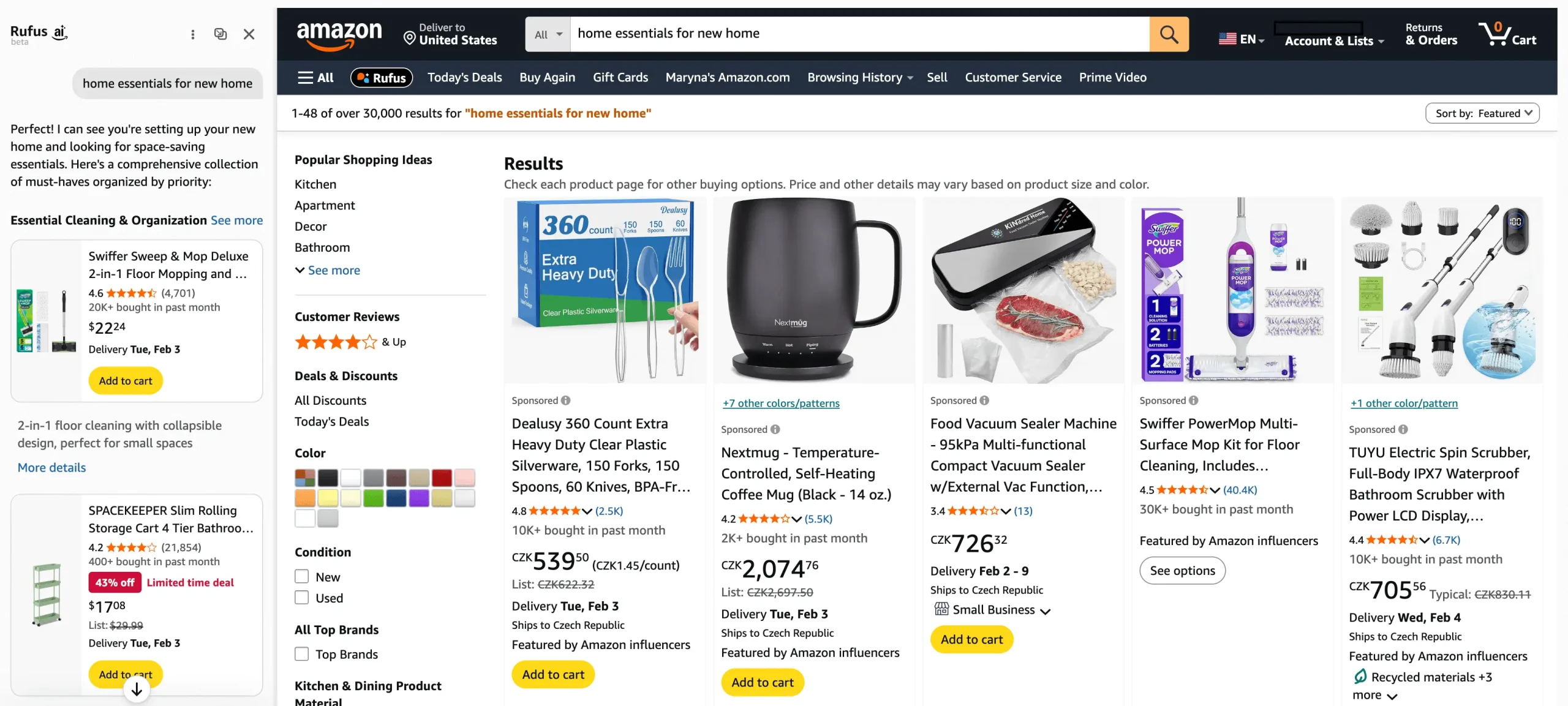
Rufus can also highlight relevant deals and help narrow the list faster.
In many searches, Rufus appears early. Shoppers may see its recommendations before scrolling through the regular results or opening several product pages. Over time, it becomes more than a quick helper.
It’s a perfect shopping companion from the first question to the final choice.
Rufus is already available to customers in the United States, the United Kingdom, and India, and is now rolling out in beta across several European markets, including Germany, France, Italy, and Spain.
What’s Happening Behind the Scenes
Rufus is not just a new search filter. It is designed as an AI assistant that guides shoppers from discovery to purchase.
It runs on Amazon Bedrock and uses several large language models, including Anthropic’s Claude Sonnet, Amazon Nova, and Amazon’s own models. Depending on the question, Amazon routes the request to the most suitable model to answer it quickly and accurately.
Rufus pulls info from many places at once. These include Amazon’s product catalog, product attributes and variations, pricing and availability, customer reviews, and community Q&As. Amazon also enriches this data with additional trusted sources.
Because of this, Rufus can answer both high-level questions and detailed ones. It can suggest the best product for a specific use case or explain small differences between similar items.
Rufus also understands context. It remembers what the shopper has already asked and adjusts recommendations as the conversation continues. The search doesn’t reset with every question.
A significant factor is personalization. Rufus uses browsing history, purchases, and preferences to ensure results are tailored to the individual.
It can also take action. Rufus adds items to the cart, tracks price changes, reorders products, and can even buy items when a target price is reached.
What Rufus Changes for Sellers
Rufus changes how products are discovered on Amazon. In many cases, customers now see AI recommendations before they interact with traditional search results.
This means keyword rankings alone are no longer enough.
For Rufus to recommend a product, it needs clear and reliable data. It doesn’t guess. It doesn’t fix mistakes. It only works with what exists in Amazon’s systems.
For example, it analyzes titles, attributes, variations, multipack logic, pricing, availability, delivery speed, reviews, and Q&A. If something is missing or inconsistent, the product becomes harder to compare.
The result is simple. An inconsistent product is less likely to appear in AI-driven recommendations.
So, the focus shifts for sellers. Keywords still matter, but clean and consistent data matters more.
How Rufus Builds Recommendations
Amazon doesn’t publish official documentation that explains how Rufus selects or ranks products. There is no guide for sellers and no list of signals to optimize against. Still, Rufus gives sellers something useful through the way it answers questions.
For example, if a shopper searches for ‘home essentials for a new house,’ Rufus doesn’t return a random list of popular items. It first interprets the request as a setup scenario. It understands that the shopper is likely furnishing or organizing a new space, not looking for one specific product.
If the shopper then asks why certain items were chosen, Rufus provides an explanation.
It talks about the intent of the request, available context from recent searches, how relevant the products are to the situation, and practical limits like space. It avoids mentioning filters, attributes, or keywords.
Based on this, sellers can make a reasonable assumption. Rufus doesn’t think in SKUs or categories. It evaluates whether a product fits a real-life use case and whether Amazon has enough clear data to be confident in recommending it.
Where M2E Cloud Fits In
Rufus is fully managed by Amazon. M2E Cloud doesn’t interact with Rufus directly and can’t influence AI recommendations.
What M2E Cloud does is help you provide high-quality, well-structured, and consistent product data to Amazon, especially when creating new ASINs. When selling under existing ASINs, you can’t modify the main product content that Amazon’s systems use.
For new ASINs, you can use M2E Custom Attributes to add product information that isn’t in your existing catalog. You can fill in the needed details to properly describe your products for Amazon without changing the original data in your store.

When joining existing ASINs, you can only control offer-level details like price, stock availability, and handling time. Selling Policies in M2E Cloud help keep these values stable and compliant.
As a final quality check, M2E Listing Validator Assistant reviews your listings before they go to Amazon and highlights gaps or errors in product data. It helps you reduce listing failures and keep your catalog aligned with Amazon’s requirements.
In Summary
Rufus brings AI into the way customers discover products on Amazon. It shapes how they explore options, compare items, and make decisions.
You can’t optimize Rufus directly as a seller. Still, you can influence what it has to work with by keeping your offer data clear and consistent. Accurate and complete product information is now a requirement, not a bonus.
The M2E Cloud enables merchants to maintain their data in a neat, tidy way, ensuring their products are always accessible and ready for a shopping experience with Rufus.

