Ecommerce has changed the way people shop, even for auto parts. Now it’s easy to find and order the parts you need on Amazon without leaving the room.
But such convenience came with a challenge for sellers. For example, if you sell auto parts on Amazon, you need to ensure customers get the right parts for their vehicles.
Compatibility information is crucial for buyers prior to placing an order. With all the info, they won’t make the wrong choice because they can be sure they have selected the right product.
For Amazon sellers, poor compatibility results in multiple problems:
- High number of returns due to incorrect parts;
- Lost sales, as customers are unable to establish compatibility;
- Extra work entering or updating data in the system manually.
These challenges only get tougher as the business scales.
With an Amazon compatibility tool, you can manage fitment data easily and prepare your listings with minimal effort.
Understanding the Amazon Fitment Data
So how does Amazon determine which component fits which vehicle? The answer lies in fitment data.
What is Amazon fitment data?
Different automotive components may not fit in every car. Depending on the vehicle type, even different models from the same manufacturer may use different components.
That is where Amazon utilizes fitment data.
In simple terms, it is a dataset that shows which automotive component fits which vehicle. Essentially, this data links product brand and part number to the specific details of the vehicle such as:
- Year, make, and model of the vehicle;
- Engine type and size;
- Trim and body type;
- Transmission or drivetrain.
For example, the ACDelco 41-993 spark plug fits the 2000 Cadillac Escalade and several other vehicles.
This information is stored using ACES (Aftermarket Catalog Exchange Standards), the industry standard for exchanging auto fit data.
How does Amazon use fitment data?
There are two possible situations:
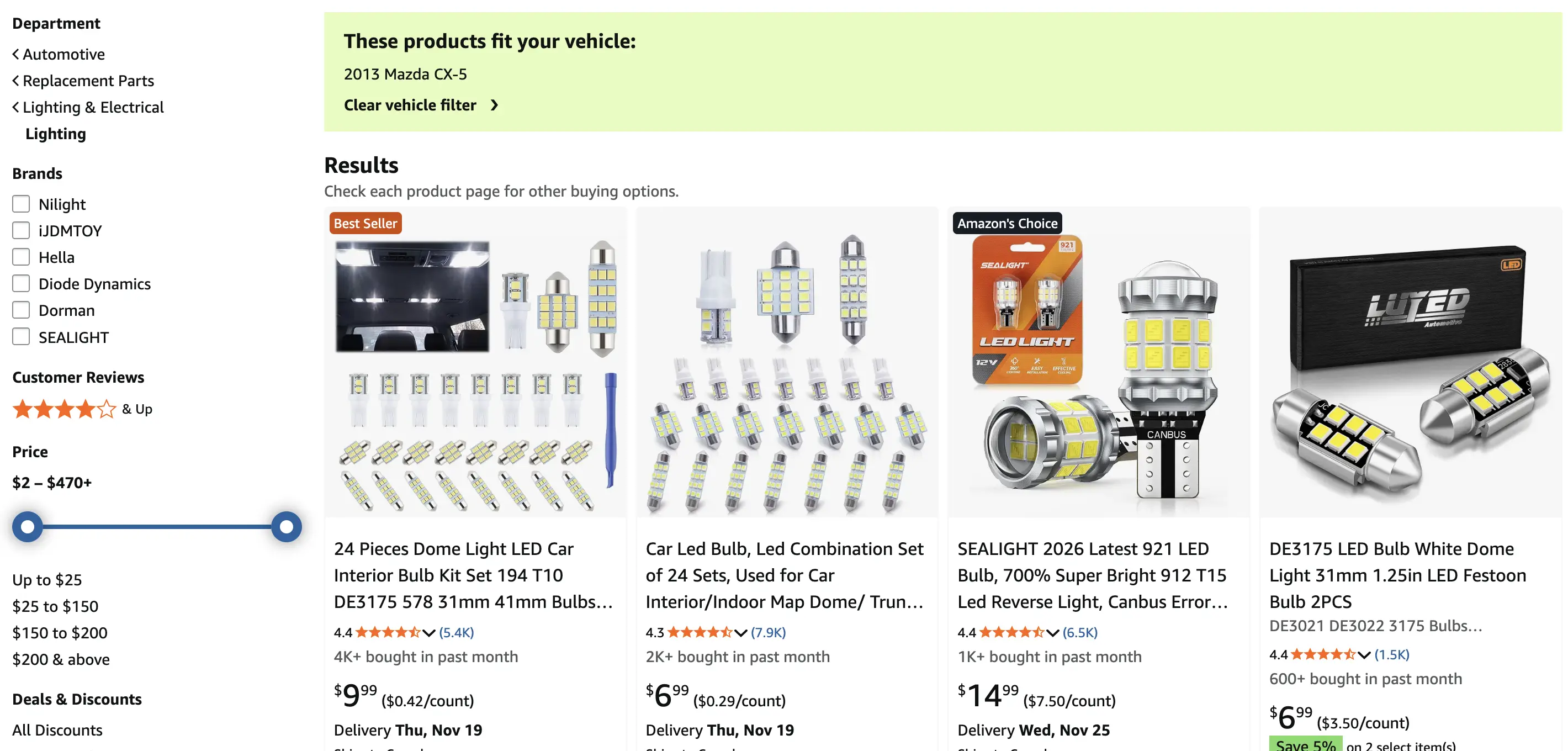
- Fitment records are missing. Customers can’t use Amazon’s tool to check whether the auto part fits their vehicle.
- Fitment records are present. Amazon checks the vehicle info the customer provided against the fitment details. After checking, it shows whether the selected part fits.
What Is Amazon Automotive Part Finder?
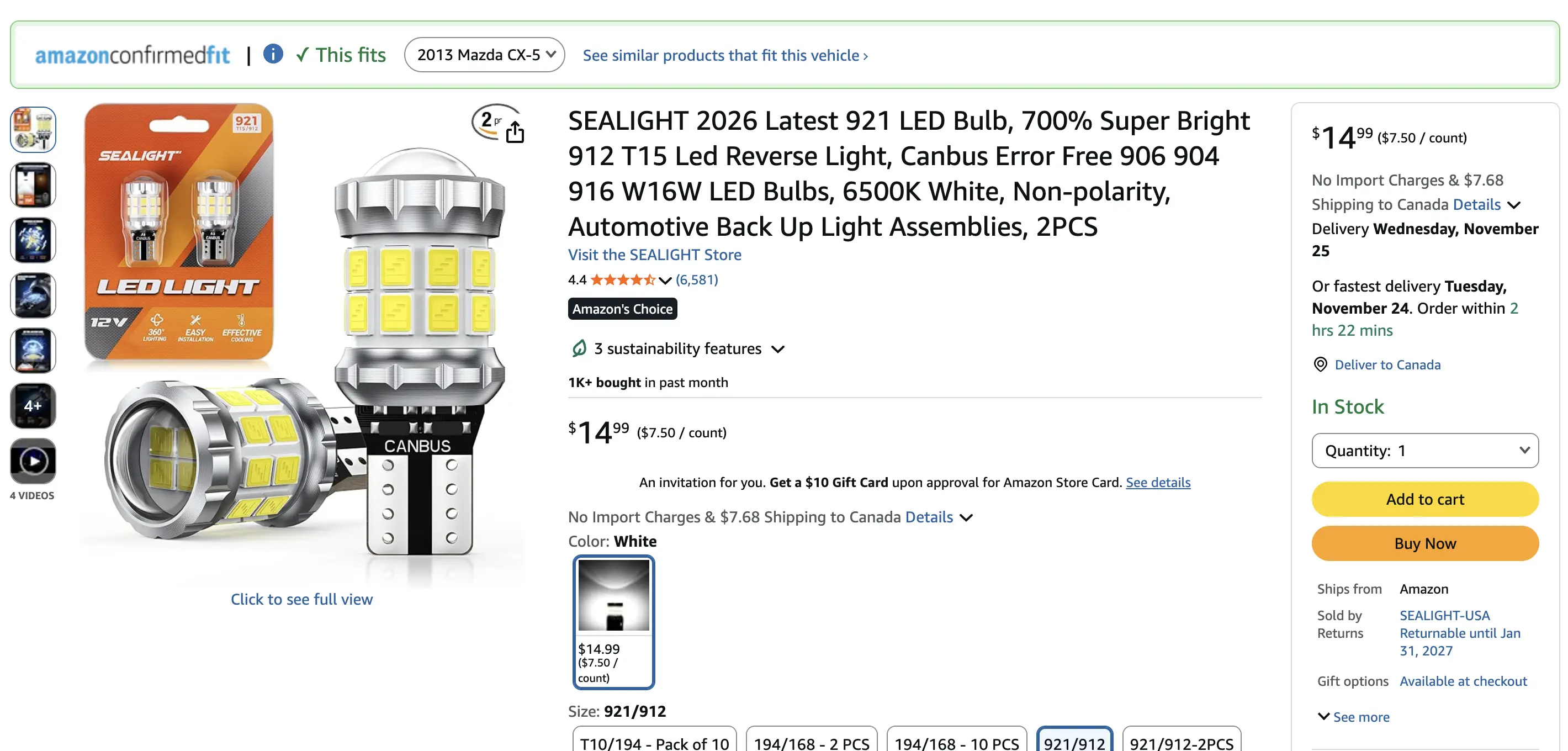
This Amazon tool makes the fitment process simpler for buyers because all they need to do is enter their vehicle details. Amazon does the rest.
How does the Part Finder work for customers?
Through Amazon Part Finder, customers can determine whether a part is compatible with their car before buying. The process involves the following steps:
- Customers enter the car’s year, make, and model.
- If Amazon needs more details, customers provide them, for example, trim level, engine type, and more.
- Amazon cross-checks the car details provided with the part’s compatibility details.
- Customers can confirm compatibility and make informed buying decisions.
Here are several Amazon features that customers find useful.
| Amazon feature | What it does |
| Part Finder stripe | Displays vehicle compatibility details directly on the product page |
| Shop Parts by Vehicle | Helps customers find parts that fit the vehicle they picked |
| Compatibility Chart | Lists all vehicles compatible with a product |
| Your Garage | Allows buyers to save their cars, or other vehicles, and use them for future searches |
Note: Part Finder specializes in automotive parts. Universal parts such as floor mats and air compressors don’t need to be verified for compatibility.
Part Finder features cars, light trucks, SUVs, vans, motorcycles, scooters, and ATVs.
What to Look for in the Best Amazon Fitment Tool
Fitment tools on Amazon vary in features. Some provide basic compatibility data, while others help manage large catalogs effectively.
So, the question arises – what should you pay attention to when selecting a fitment tool? Four aspects deserve your attention.
1. Automated fitment validation
Automotive databases are continuously updated, so car compatibility data doesn’t remain valid forever.
There are two issues that arise from it:
- Outdated data – some components may still be associated with vehicle configurations that are no longer in the database.
- Fitment gaps – updated or new car configurations can be missing in your compatibility database.
Therefore, customers will be unable to find your products if they search for compatible parts.
You need to develop a solution that will check your fitment data against current automotive databases. Through the help of this tool, you will be able to spot old data and cars without any fitment at all.
2. Bulk editing and fitment reports
Consider how you would control the compatibility information of various auto parts with hundreds, if not thousands, of products in your catalog. Making changes for each component would be endlessly time-consuming.
In this situation, bulk editing is critical.
An effective Amazon fitment tool should provide you with the ability to:
- Export fitment data to Excel;
- Update many records simultaneously;
- Control a wide range of fitments without revising each product separately.
3. Fitment inheritance for Amazon
Other auto parts also have identical compatibility features. You don’t need to enter the same information for all products; fitment inheritance will be helpful.
The process of fitment inheritance is as follows:
- Enter the compatibility information of the parent part.
- Connect the child parts with similar attributes.
- The child parts will inherit information from the parent part.
This technology prevents the repeated entry of the same vehicle information. It will be particularly helpful when multiple parts have identical compatibility.
4. Helpful docs and support
Without knowing ACES standards, the process of managing fitment data can feel daunting.
When picking a specific tool, find out whether it has some of these features:
- A knowledge base with clear guidelines;
- Explanations for validation, data formatting, and inheritance of fitment;
- Some clarifications regarding major compatibility problems;
- Customer service via live chat or email.
Well-written documentation gives you clear information on how different parts of the process work, while reliable customer service provides backup when things get tough.
The right fitment tool should make your daily work easier, not more complex.
Why is a fitment tool so important?
This is not only about how to structure your fitment data. Effective fitment data management can significantly affect your sales and business processes.
The benefits of fitment data management are:
- Decrease in returns – help your clients choose wisely and not purchase inappropriate products.
- Increased product visibility – make it easier for clients to find your products through search engines when purchasing automotive parts.
- Update fitment information – identify missing vehicle information and update it regularly.
- Reduce manual labor – update fitment information for all products at once and use it for product compatibility.
- Client satisfaction – provide clients with all necessary information in order to make the right choice.
But accurate product info isn’t all you need. If you sell thousands of auto products on Amazon, you need to manage your listings, inventory, prices, and orders.
Run Your Automotive Business on Amazon with M2E Cloud
Let’s begin with the basics – M2E is a tool that links your ecommerce store (such as Shopify) to Amazon to enable you to manage your automotive business better.
So, what can you do with M2E Multichannel Connect?
Using M2E, you can manage product information for your Amazon listings in bulk.
- Bulk fitment application: Select a number of products and apply relevant fitment data.
- Product data management: Add new information to existing products or replace outdated information with new information.
- Use existing product information: Use the information from your ecommerce catalog without entering it manually.
- Manage large catalogs: Manage many products at once instead of managing them individually.
- Check info before publishing. Run M2E Validator Assistant to review whether your products meet Amazon’s listing requirements before you list them. Validator highlights missing or incorrect details and explains how to resolve each issue so your items can be listed without delays.


And what’s more important – you don’t even need to go to the M2E app to update info since it’s a native integration. Just use your ecommerce platform (Shopify, BigCommerce, WooCommerce, and others), and let M2E push the updates to Amazon.
By the way, M2E allows you to connect your store to 600+ marketplaces and manage everything from one dashboard. So, all linked marketplaces always stay in sync, including inventory, prices, and orders.
Learn more about M2E Multichannel Connect features by following this link.
The Hunt for the Proper Amazon Fitment Tool
By picking the proper Amazon fitment tool, you will be able to maintain correct compatibility data, avoid incorrect orders, and improve customer experience. It just makes it easier to find compatible parts on Amazon.
And in case you want to manage listings, inventory, pricing, and orders in multiple marketplaces, M2E Cloud allows you to integrate all these tasks into one place.
Just connect your online store to Amazon and manage your automotive business from one place. Book a demo today to find out the details.