Let’s face it – if you want to be a successful marketplace seller, it’s not enough to just connect your account. You also need to manage product publishing, stock updates, and order fulfillment. As you add more channels, the integration becomes as important as the connection itself.
M2E Multichannel Connect and UniCon – Unified Multichannel Connector – both help with these tasks. However, the two solutions differ in the number of supported source platforms, the number of marketplaces connected, and their configuration features.
This guide compares both solutions based on supported channels, listing functionality, automations, and fulfillment options.
M2E Multichannel Connect vs UniCon: Quick Comparison
M2E and UniCon serve similar purposes in marketplace management, yet they have several notable differences.
| Feature | M2E Multichannel Connect | UniCon – Unified Multichannel Connector |
| Product sources | ecommerce platforms, POS, catalogs, APIs | Amazon, Walmart, Shopify |
| Marketplace coverage | 600+ marketplace integrations | 8 supported channels |
| AI listing tools | Attribute mapping and Intelligent Listing Assistant | AI attribute mapping with seller approval |
| Automation | Selling Policies, sync settings, Automation Rules | Inventory sync, pricing updates, order routing |
What else should you know?
- Fulfillment: Both support Amazon MCF and Walmart MCS workflows.
- Price: M2E starts at $49/month, making its entry-level price lower than UniCon’s $99/month starting price. Features and available integrations vary by plan and setup.
Supported Integrations: Where Can You Sell?
The ideal connector should be compatible with the existing environment and the marketplaces that you would like to join in the future. Here we compare M2E and UniCon.
UniCon supported sources & destinations
UniCon creates marketplace integrations based on the already existing catalogs.
Choose your product source:
- Amazon
- Walmart
- Shopify
Choose your sales channels: Amazon, Walmart, Shopify, TikTok Shop, SHEIN, Temu, eBay, and Target Plus.
Let’s say you are selling through Amazon. With UniCon, you can use your Amazon catalog to prepare products for TikTok Shop instead of starting from scratch.
M2E Multichannel Connect integrations
M2E helps businesses reach their target audience through various marketplaces. The main idea is that you don’t need to rebuild your ecommerce setup to start selling on the marketplaces.
Choose your product source:
- Shopify, BigCommerce, WooCommerce, Ecwid, Shopware, and PrestaShop;
- Salesforce Commerce Cloud;
- Lightspeed POS and Square POS;
- Magento or Adobe Commerce via M2E Pro;
- ERP, PIM, or custom product catalogs via M2E Cloud API, M2E Catalog, or CSV import.
Choose your sales channels:
- Amazon, eBay, and Walmart;
- TikTok Shop, Temu, and SHEIN;
- Kaufland, OTTO Market, and OnBuy;
- Marketplaces powered by Mirakl, such as Decathlon and Carrefour.
You don’t need to change your platform every time your business takes a new direction. M2E lets you connect additional marketplaces to your existing setup and manage everything in one place. Whether you have hundreds or thousands of products, you can automate daily tasks and spend less time on manual updates.
M2E is a flexible tool. It provides a bunch of sync features for you to automate marketplace selling. For example, the copy to TikTok Shop feature allows you to transfer your active Amazon listings to the mentioned marketplace.
The feature is also available for other marketplaces like eBay, Walmart, and Temu.

💡 So, the main question to ask – which tool fits your plans? UniCon builds its solution around an existing Amazon, Walmart, or Shopify catalog. M2E gives sellers more freedom to choose their source system and expand into additional markets.
Also, consider the marketplace coverage and whether you want to grow without rebuilding your setup. With M2E, you can expand to 600+ integrations without switching your integration platform. UniCon doesn’t give you such flexibility. And if you want to expand to European markets, like Shop Apotheke or Boulanger, in the next five years, you’d better pick a tool that provides broader marketplace coverage and scalable automation.

Product Listing and AI-Assisted Preparation
You have hundreds of products ready to sell. But every marketplace has its own rules. One may require specific product attributes. Another may have strict rules for barcodes, categories, or prices.
So, the question is obvious – how do M2E and UniCon help you manage these differences?
How UniCon uses AI to map attributes
UniCon helps sellers adapt existing product data to new marketplaces.
For example, your catalog may use the field ‘Size’, while another marketplace requires ‘Item Size.’ UniCon’s AI can suggest a match.
Here’s how it works:
- Import products from your existing catalog.
- Get AI suggestions to match product fields.
- Review and approve the matches before submitting listings.
UniCon also helps you check missing data and fix errors when listings fail.
How M2E verifies info with Intelligent Listing Assistant
Preparing marketplace listings shouldn’t mean entering the same product details over and over or guessing why a listing has errors.
M2E gives you two tools to make the process easier.
It’s easier to explain with an example. So, imagine you have a Shopify store connected to eBay, Amazon, and Kaufland.
1. Map your product data
Your main catalog stays the primary source of data. M2E just syncs the required information for each marketplace.
- Link the Shopify attributes and custom fields with the Amazon specifications through Category Policies;
- Save the policy and reuse maps in suitable listings.
2. Validate your listings before publishing
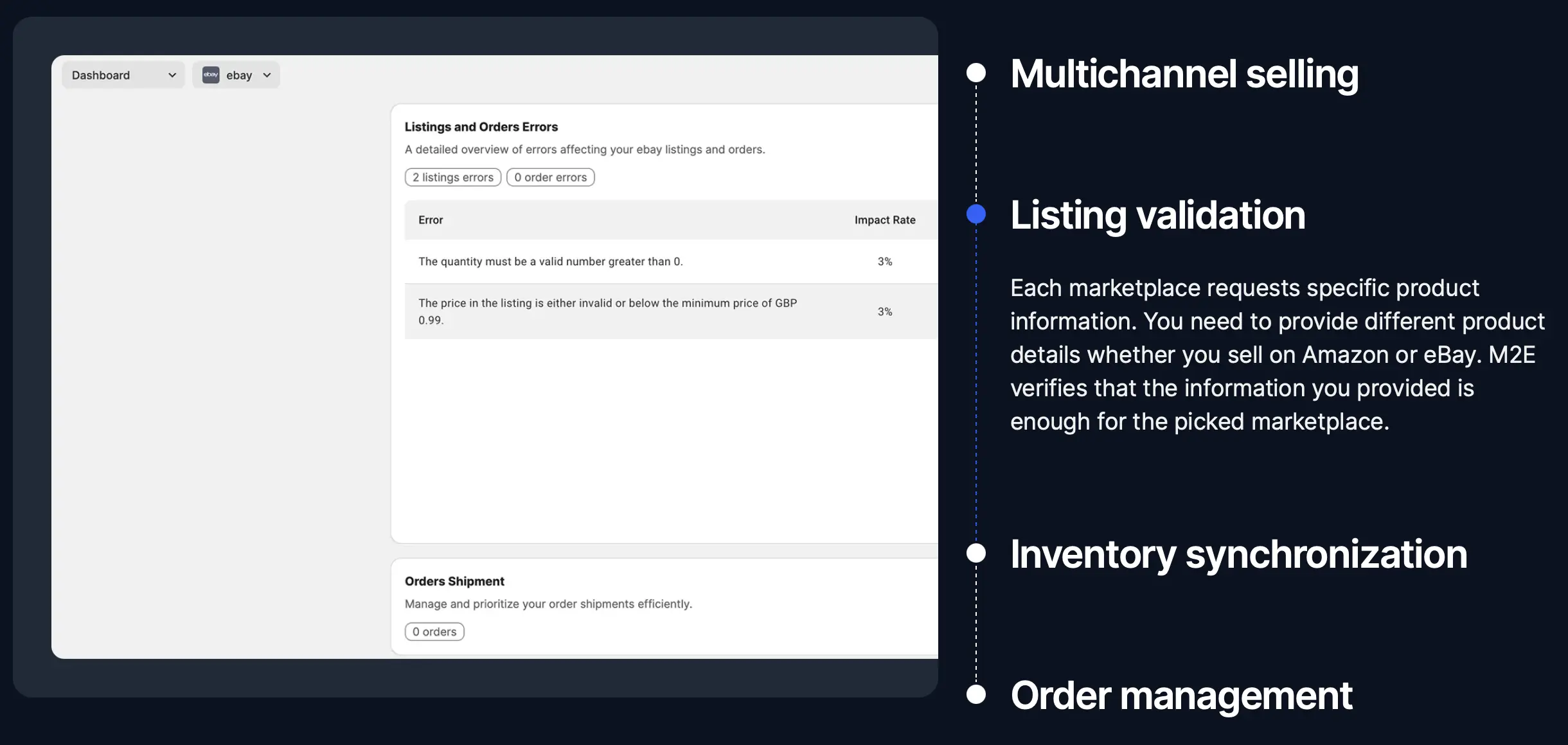
The M2E Intelligent Listing Assistant verifies product information when you upload it.
- Find missing barcodes, invalid values, and required attributes.
- See what went wrong and get instructions to fix it.
- Revalidate your product after making changes.
- Save unfinished listings as Incomplete and return later.
💡 The result? Less manual checking and a clearer path from product data to marketplace-ready listings.
Inventory, Pricing, and Automation Rules
Not all marketplaces require the same product price or the same stock quantity. For example, you may want to reserve certain items and set a higher price on one of the channels. Automation of inventory and pricing processes is supported by two options: UniCon and M2E; however, they differ in how they manage these processes.
UniCon: Sync stock across your sales channels
UniCon can synchronize stock and prices across connected marketplaces.
- Inventory synchronization. Automatic stock updates across all sales channels when products sell.
- Price synchronization. Store uniform prices for products on all marketplaces.
- Stock notifications. When stock runs low for an item, it sends inventory shortage notifications to connected channels.
M2E: Set rules that fit your business
With M2E, you can adjust your strategy for each marketplace based on your inventory and prices.
- Selling Policies. Control pricing and inventory strategies for each marketplace. You can establish different rules for each sales channel or group of products.
- Synchronization Policies. Specify which parameters get synchronized from your store, including prices, stocks, names, and pictures.
- Automation Rules. Determine if the listing on the marketplace remains active or is removed when the product at its source is deleted.
💡 Let’s see how it works.
Imagine that you are selling a certain product on Shopify and eBay.
The Shopify stock shows 20k items available, but you want only 15k to be displayed on eBay and want to have five pieces in reserve. Furthermore, you would like to charge a higher price for the same product on eBay than on Shopify.
With M2E, you can have information about 15k products on eBay and increase the eBay price by 10%.
If stock levels on Shopify change, M2E will automatically update the quantity on eBay.
Order Management and Multichannel Fulfillment
Getting orders is one thing. Managing them is another. Especially if you’re a marketplace seller.
You need to see what’s sold, what still needs to go out, and what has reached the customer.
UniCon and M2E approach order tracking differently.
UniCon: Having only one order processing area
Through UniCon, orders received by the retailers via various channels are combined into an easy-to-use dashboard, which gives you an opportunity to:
- Monitor orders from various sources.
- Verify payment and shipping statuses.
- Utilize order details.
- Monitor orders before sending them.
M2E: Order management in your online store
With M2E, you don’t need to create an order management dashboard for different marketplaces; orders simply appear in your store.
For example, all orders you receive from eBay, Amazon, and other connected marketplaces can be managed in your online store, where you usually manage orders.

Both tools support Amazon and Walmart fulfillment.
If you are using either Amazon FBA or Walmart WFS, the connectors can help you sell that inventory on other channels.
💡The key difference: Both tools help automate fulfillment, but M2E offers more scalability for businesses that manage multiple stores, marketplaces, and sales channels.
Performance Tracking, Pricing, and Scalability
As your business grows, you need clear sales data and a plan that can keep up. Here’s how M2E and UniCon compare.
Get the overview with analytics and reporting
M2E Sales Analytics brings together performance data from Amazon, eBay, Walmart, TikTok Shop, and Temu.
You can use it to:
- Compare revenue across marketplaces;
- Track sales trends;
- Find your top-performing and weakest products.

Compare the pricing at a glance
M2E Multichannel Connect
- $49/month starting price
- 30-day free trial
- GMV-based pricing
- Three integrations on Starter; eight on Business
- Mirakl access from Business onward
UniCon
- $99/month starting price
- 14-day free trial
- Limits based on listings, monthly orders, and connected channels
- Two destination channels on standalone Starter
- All eight channels on higher standalone
💡 Which is the better fit? You need to understand what you need most.
- Growing sales? Check how M2E’s GMV-based tiers affect your costs.
- Adding products? Review UniCon’s listing and order limits.
- Expanding to more marketplaces? Examine the number of channels and integrations in different plans.
The best choice will be a cost-effective plan that provides services to keep pace with your growing company.
Instead of the Conclusion: Which Solution Is Best for Your Business?
You need to decide which sales channels to implement and which systems to choose. UniCon and M2E Multichannel Connect have different functionalities that can meet your business needs.
Go with UniCon if you need to:
- Add products to your catalog: Sell the products from Amazon, Walmart, and Shopify on supported sites.
- Speed up listing creation: Use the automatic assistant to align product characteristics with marketplace requirements.
- Monitor orders in one place: Manage all orders and processing from a single interface.
- Connect to fulfillment service providers: Integrate your marketplace orders with Amazon or Walmart services.
Go with M2E Multichannel Connect if you need to:
- Integrate your systems: Synchronize various ecommerce solutions, POS systems, and catalogs.
- Expand to more marketplaces: Selling products across the US and Europe is possible.
- Set prices and stock rules: Prices and stock may be adjusted.
- Discover listing mistakes: The Intelligent Listing Assistant will assist with identifying and resolving errors.
- Use your current commerce solution: Manage every transaction without changing the platform.
💡 Before you decide: Verify if the solution is integrated with your marketplace and supports the required features.
Find out which solution fits your workflows and sales channels. Book your M2E demo today.