


Powstanie wspólnych marketplace’ów zmieniło sposób, w jaki firmy i osoby prywatne kupują i sprzedają towary. Platformy te, w tym Amazon, eBay, Walmart, Etsy, TikTok Shop i Temu, zapewniają przestrzeń, w której wielu sprzedawców może dotrzeć do szerokiego grona odbiorców.
Każdy marketplace działa w oparciu o unikalny mechanizm, obsługując różne typy sprzedawców i kupujących. Na tym blogu dowiemy się, jak działają te platformy, poznamy ich kluczowe koncepcje i przykłady ilustrujące ich modele biznesowe.
Zrozumienie współdzielonych marketplace’ów
Shared marketplace to platformy internetowe, które łączą wielu kupujących i sprzedających, umożliwiając dokonywanie transakcji przy minimalnym tarciu.
W przeciwieństwie do tradycyjnych modeli detalicznych, w których pojedynczy podmiot kontroluje zapasy i sprzedaż, znaczenie gospodarki współdzielenia obraca się wokół wymiany peer-to-peer, w której osoby fizyczne dzielą się dostępem do towarów i usług za pośrednictwem platform cyfrowych.
Platformy te działają jako pośrednicy, zapewniając infrastrukturę dla płatności, wysyłki, obsługi klienta, a czasem usług realizacji.
Kluczowe cechy wspólnych marketplace’ów
- Wielu sprzedawców, jedna strona internetowa – kilku niezależnych sprzedawców umieszcza swoje oferty na wspólnej platformie, dając konsumentom różne możliwości wyboru.
- Narzędzia do zarządzania sprzedażą – marketplace’y często udostępniają narzędzia do zarządzania sprzedażą, zamówieniami, dostawami i innymi operacjami, ułatwiając sprzedawcom usprawnienie ich działalności.
- Prowizja lub opłaty abonamentowe – sprzedawcy płacą marketplace prowizję od każdej sprzedaży lub cykliczną opłatę abonamentową za utrzymanie swojego sklepu.
- Ujednolicona publiczność – platformy marketplace online umożliwiają firmom i osobom prywatnym sprzedaż produktów lub usług globalnej publiczności przy minimalnych kosztach konfiguracji.
- Konkurencja – sprzedawcy na wspólnym marketplace konkurują ceną, jakością i ocenami, co napędza innowacje i lepszą obsługę klienta.
- Dopasowanie oparte na technologii – algorytmy i optymalizacja wyszukiwania pomagają kupującym szybko znaleźć najbardziej odpowiednie produkty.
- Skalowalność – sprzedawcy mogą rozwijać swoją działalność bez konieczności budowania własnej strony internetowej lub wykorzystywania ruchu i infrastruktury marketplace.
- Zaufanie i bezpieczeństwo – Marketplace’y wdrażają systemy weryfikacji, polityki ochrony kupujących i mechanizmy zapobiegania oszustwom w celu zapewnienia bezpieczeństwa transakcji.
Ogólnie rzecz biorąc, marketplace łączy kupujących i sprzedających, umożliwiając dokonywanie transakcji w scentralizowanym środowisku online.
Korzyści dla kupujących i sprzedających
Dla kupujących:
- Szeroki wybór produktów i konkurencyjne ceny.
- Wygoda dzięki wielu sprzedawcom w jednym miejscu.
- Recenzje i oceny umożliwiające podejmowanie świadomych decyzji zakupowych.
Dla Sprzedających:
- Dostęp do dużej grupy odbiorców z wbudowanym ruchem.
- Wsparcie w zakresie logistyki i obsługi płatności.
- Narzędzia reklamowe i promocyjne zwiększające sprzedaż.
Kluczowe kwestie dotyczące współdzielonych marketplace’ów
4 Trendy w rozwoju marketplace’ów online
Sztuczna inteligencja (AI) przekształca wspólne marketplace’y, czyniąc zakupy bardziej spersonalizowanymi, wydajnymi i bezpiecznymi.
Zaawansowane algorytmy analizują zachowania klientów, historię zakupów i wzorce przeglądania, aby dostarczać dopasowane rekomendacje produktów, zwiększając zaangażowanie i współczynniki konwersji.
Dynamiczne ceny dostosowują się w czasie rzeczywistym w oparciu o popyt i trendy konkurencji, pomagając sprzedawcom zachować konkurencyjność.
Oparte na sztucznej inteligencji chatboty i wirtualni asystenci usprawniają obsługę klienta, zapewniając natychmiastowe odpowiedzi i kierując decyzjami zakupowymi.
Ponadto systemy wykrywania oszustw stale monitorują transakcje, identyfikując podejrzane działania, aby zapobiegać oszustwom i nieautoryzowanym zakupom.
Te innowacje oparte na sztucznej inteligencji zapewniają płynne zakupy, jednocześnie optymalizując operacje na marketplace dla sprzedawców.
Aby zobaczyć, jak rozwiązania AI są wdrażane w różnych branżach – w tym w handlu elektronicznym – przyjrzyj się, jak Azumo stosuje sztuczną inteligencję w celu poprawy personalizacji, automatyzacji i obsługi klienta na dużą skalę.
Ciekawostka: Według badania przeprowadzonego przez McKinsey, personalizacja może zwiększyć przychody z handlu elektronicznego o 10-30% poprzez zwiększenie zaangażowania i utrzymania klientów.
McKinsey Study
Rzeczywistość rozszerzona (AR) i wirtualne przymierzalnie rewolucjonizują zakupy online, rozwiązując problem braku możliwości fizycznej interakcji z produktami.
Narzędzia AR pozwalają klientom wizualizować meble i wystrój domu w ich przestrzeni przed zakupem, zwiększając zaufanie do ich wyborów.
Wirtualne przymierzalnie w modzie wykorzystują skanowanie ciała oparte na sztucznej inteligencji, aby polecić najlepsze dopasowanie, znacznie zmniejszając liczbę zwrotów.
Marketplace’y kosmetyczne i okularowe wykorzystują AR do wirtualnych przymiarek, umożliwiając klientom natychmiastowe przetestowanie makijażu, okularów i fryzur.
Ponadto podglądy produktów 3D zapewniają wciągające wrażenia zakupowe, pomagając kupującym w podejmowaniu bardziej świadomych decyzji.
Technologie te wypełniają lukę między fizycznym i cyfrowym handlem detalicznym, zwiększając zaangażowanie i współczynniki konwersji.
Interesting Fact: AR-driven shopping experiences can increase conversion rates by 40% as customers feel more confident about their choices.
Shopify Blog
Blockchain technology enhances trust and transparency in shared marketplaces by enabling secure, decentralized transactions.
Removing intermediaries facilitates direct peer-to-peer payments, reducing processing fees and delays. Smart contracts automate agreements between buyers and sellers, minimizing disputes and fraud.
Additionally, blockchain improves supply chain transparency by tracking product origins ensuring the authenticity of luxury goods, electronics, and food.
Digital marketplaces also leverage NFTs for ownership verification of digital assets, artwork, and exclusive physical products.
Interesting Fact: The blockchain supply chain market is projected to grow from USD 1.26 billion in 2025 to USD 9.52 billion by 2030, reflecting a compound annual growth rate (CAGR) of 49.87%.
Mordor Intelligence
Omnichannel sales are becoming essential as consumers expect a seamless shopping experience across online stores, physical locations, and social media platforms. Marketplaces now integrate Click & Collect (BOPIS) services, allowing customers to buy online and order in-store for added convenience. Modern commerce increasingly relies on digital-first tools, from QR-based menus in restaurants and contactless payment systems to a modern business card solution that allows professionals to instantly share their contact details and portfolios without relying on traditional printed materials.
Social commerce is also booming, with platforms like TikTok Shop and Instagram Shopping enabling direct purchases. Retailers enhance in-store experiences with QR codes, interactive kiosks, and mobile apps, blending digital engagement with physical shopping.
If you want to learn more about how to connect offline and online sales read this blog.
Interesting Fact: 73% of consumers use multiple channels before purchasing, highlighting the importance of an omnichannel approach in modern retail.
Harvard Business Review
4 Secrets of Successful Selling on Marketplaces
Selling on shared marketplaces requires more than just listing products—building trust, understanding consumer behavior, and leveraging data-driven strategies to maximize conversions. Here’s a deep dive into the key factors that contribute to success.
#1: Manage Reviews & Ratings to Build Trust
Reviews and ratings significantly influence purchasing decisions, shaping a seller’s reputation and sales. Encouraging honest feedback and professionally addressing negative reviews builds trust and loyalty.
User-generated content, including customer reviews, photos, and videos, is essential in building trust and authenticity. However, it can also sometimes contain harmful or inappropriate material. Tools such as Utopia Analytics provide automated content moderation, enabling sellers and marketplace managers to monitor and manage reviews, comments, and other user submissions in real time. This approach helps ensure a safer online space, preserving brand reputation while fostering trust and engagement.
Interesting Fact: 95% of consumers read online reviews before making a purchase, and products with at least five reviews are 270% more likely to be purchased than those with none.
Spiegel Research Center
#2: Use Analytics to Optimize Product Assortment & Pricing
Data-driven insights help sellers optimize product selection and pricing for maximum profitability.
Identifying high-performing products allows for strategic restocking and bundling, while dynamic pricing tools ensure competitive yet profitable pricing.
Seasonal and trend analysis helps predict demand, enabling better inventory planning.
A/B testing product titles, descriptions, and images further refine listings, boosting conversions and driving sales growth.
Interesting Fact: Retailers that effectively apply a comprehensive set of assortment analytics can increase their gross margins by up to four percentage points.
Forbes
#3: Study Buyer Psychology
Understanding consumer psychology helps sellers boost conversions by leveraging key triggers.
Scarcity and urgency tactics like countdown timers and low-stock alerts create FOMO, driving quicker purchases.
Social proof, such as bestseller tags and high review counts, builds trust and reassures buyers.
Free shipping and hassle-free returns reduce friction, making purchases feel risk-free. Bundling discounts and upsells increases order value.
Interesting Fact: Over 70% of online shoppers abandon their carts. Adding urgency, trust signals, and seamless checkout options can significantly reduce this rate.
Baymard Institute
#4: Use Advertising Across Different Marketplaces
Effective advertising maximizes visibility and sales across marketplaces. Amazon Sponsored Ads, eBay Promoted Listings, and TikTok Shop Ads boost exposure through high-traffic placements and viral content.
Google Shopping, Instagram, and Facebook Marketplace expand reach across multiple platforms while retargeting campaigns re-engage visitors who didn’t convert. A well-structured ad strategy drives sustained growth and stronger marketplace performance.
This kind of sustained growth depends on how well advertising strategies are localized for each region. While markets like the US or UK often rely on long-term planning and consistent messaging, places like Dubai demand quicker pivots and trend-aware content to keep up with highly engaged, mobile-first audiences. In this context, effective social media management in Dubai plays a key role in ensuring ads resonate across both traditional marketplaces and emerging platforms. Without this regional insight, even strong campaigns can underperform in dynamic markets.
Interesting Fact: Retailers see a 53% increase in conversion rates when using marketplace advertising effectively.
Cornell University
Read more about e-commerce essential tips in our blog and find how to create the product descriptions that sell.
4 Key Legal and Tax Aspects
#1: Product Certification Requirements & GPSR Compliance
Selling on global marketplaces requires adherence to strict product safety regulations. The EU’s General Product Safety Regulation (GPSR) mandates technical documentation, digital product labeling, and traceability obligations, with non-compliance leading to fines or product bans.
Additionally, marketplaces enforce these standards by requiring proof of compliance before listing. Ensuring certifications like CE marking (EU), UKCA (UK), or FCC (US) helps sellers avoid legal risks and marketplace restrictions.
#2: Website Accessibility Compliance (A11Y, EN 301 549, WCAG 2.2, ARIA)
Digital accessibility is becoming a legal requirement, with regulations like EN 301 549 (EU), WCAG 2.2, and ARIA ensuring online marketplaces are inclusive for users with disabilities.
Compliance means offering alt text for images, closed video captions, and accessible navigation without a mouse. Non-compliant platforms risk fines or accessibility lawsuits, making accessibility an ethical priority and a legal necessity for e-commerce success.
#3: Intellectual Property Protection & Avoiding IPR Issues
Intellectual property laws protect trademarks, copyrights, and patents, making unauthorized reselling or counterfeiting a significant legal risk. Marketplaces actively remove infringing listings, and sellers must verify product authenticity, avoid trademarked terms, and use original content.
Programs like Amazon Brand Registry and Transparency Program help protect against counterfeit listings while ensuring compliance with IP laws.
#4: Tax Obligations for Marketplace Sellers
International sellers must comply with VAT (EU, UK), sales tax (US), and import duties. The EU’s OSS system simplifies VAT reporting, while platforms like Amazon and eBay automatically collect VAT in certain regions.
In the US, Marketplace Facilitator Laws shift tax collection to marketplaces, but sellers must still track state-level requirements. Failure to comply can lead to penalties, account suspensions, or even legal action, making proactive tax management essential.
The Most Popular Shared Marketplaces
Marketplace systems integrate various technologies to support transactions, vendor management, and logistics. It’s time to uncover the key models for the most popular.


Amazon: The Hybrid Marketplace Giant
Amazon operates as both a retailer and a marketplace. It sells its products while allowing third-party sellers to list and distribute items through its platform. Amazon provides sellers with various fulfillment options, including Fulfillment by Amazon (FBA), where Amazon handles storage, packaging, and shipping.
If you are familiar with this marketplace, check out this article to learn why your product is not selling on Amazon and how to boost your sales.
How It Works:
- Seller Registration – Individuals and businesses create a seller account and list products.
- ASIN (Amazon Standard Identification Number): Every product listed on Amazon is assigned a unique ASIN, which helps organize the catalog, make it searchable, and identify products.
- Fulfillment Options – Sellers can choose between self-fulfillment or Fulfillment by Amazon (FBA), where Amazon manages storage, shipping, and customer service. You can straightforward multi-channel Amazon FBA integration with M2E Cloud.
- Prime and Fast Shipping—Sellers enrolled in FBA can access Amazon Prime benefits, including fast and free delivery. This attracts more buyers and increases conversion rates.
- Buy Box Competition—Multiple sellers can offer the same product, competing for the Buy Box and significantly impacting sales. Price, fulfillment method, and seller performance influence Buy Box eligibility.
- Customer-Centric Approach – Amazon enforces strict quality control customer reviews and offers buyer protection programs to ensure customer satisfaction.
- Brand Registry & Protection – Amazon offers Brand Registry for trademark owners, providing tools to protect intellectual property, combat counterfeiting, and enhance brand presence.
- Global Marketplace – Amazon operates in multiple countries, allowing sellers to expand internationally using programs like Amazon Global Selling and Pan-European FBA for European markets.
You can try M2E Cloud`s Amazon inventory management software to empower your Amazon store with inventory management software.
eBay: The Auction-Based Marketplace
eBay pioneered the online auction model, allowing users to sell products through fixed-price and auction-based listings. It caters to collectors, second-hand sellers, and businesses looking for flexible pricing structures.
How It Works:
- Key Model – Unlike Amazon’s catalog-based system, eBay operates as an open marketplace where multiple sellers can independently list identical or unique products, often competing on listing quality, pricing, and seller reputation.
- Listing Creation – Sellers can list items as auctions or fixed-price (Buy It Now), allowing for flexible selling strategies. Auctions enable competitive bidding, while “Buy It Now” offers immediate purchases. To add engaging eBay product descriptions in a few clicks, you can try M2E Cloud integration for eBay.
- Bidding Process – Buyers place bids on auctioned items until the listing expires, with the highest bidder winning. Sellers can set reserve prices and automatic bidding options.
- eBay Motors – A dedicated platform for selling vehicles, parts, and accessories, offering specialized listing features like compatibility search (fitment data) to help buyers find the right vehicle parts. You can sell on eBay Motors and reach millions of buyers with M2E Cloud for eBay Motors integration. Remember to check this article to learn more about what car parts you can sell on eBay Motors.
- Buyer-Seller Interaction – eBay allows negotiation through „Best Offer,” where buyers propose a price, and sellers can accept, decline, or counteroffer. Still, to know more about how “Best Offer” works, read this blog.
- Transaction Handling – eBay facilitates payments through eBay Managed Payments, streamlining transactions and ensuring sellers receive payouts securely. Seller protection programs help safeguard against fraudulent claims.
- Shipping & Feedback System – Sellers manage their fulfillment, offering different shipping options, including eBay’s Global Shipping Program (GSP) for international sales. Buyers leave feedback and ratings, which impact a seller’s credibility and visibility.
- eBay’s Seller Levels – Sellers can achieve Top Rated Seller (TRS) status, gaining benefits like fee discounts and higher visibility based on performance metrics like shipping speed, customer service, and transaction volume.
- Category-Specific Rules – eBay tailors listing requirements based on categories, such as authenticity verification for luxury goods, electronic IMEI checks, and vehicle history reports for eBay Motors listings. European sellers should also keep in mind new GPSR requirements.
Walmart Marketplace: A Competitive Alternative
Unlike Amazon, Walmart does not sell third-party products but allows external sellers to list items on its website (alongside Walmart’s own inventory). Walmart Marketplace gives businesses access to millions of customers while maintaining strict seller standards. If you want to learn how to sell products at Walmart, check out this blog.
How It Works:
- Application Process – Instead of open marketplaces like eBay, Walmart requires sellers to apply and meet quality and performance criteria, including a proven track record of e-commerce success, competitive pricing, and fulfillment capabilities. Approval can take several weeks.
- Product Listing and Optimization – Walmart has strict guidelines for product titles, descriptions, images, and attributes to ensure consistency across listings. Sellers must adhere to UPC (Universal Product Code) and GTIN (Global Trade Item Number) requirements for product identification.
- Buy Box Competition – Like Amazon, Walmart’s Buy Box prioritizes sellers with the best pricing, fulfillment speed, and performance metrics. The lowest price doesn’t always win; Walmart factors in shipping speed and seller reliability.
- Fulfillment Options – Sellers can either self-fulfill orders or use Walmart Fulfillment Services (WFS), which offers warehousing, fast shipping, and customer service similar to Amazon’s FBA. WFS products qualify for Two-Day Delivery, boosting visibility and conversions.
- Competitive Pricing Requirements – Walmart actively price-matches competitors and enforces price parity rules, meaning sellers cannot list lower prices on other marketplaces (including their website). Listings with higher prices may be delisted.
- Walmart’s Sponsored Ads – Walmart Marketplace offers advertising solutions like Sponsored Products to increase visibility. Unlike Amazon’s PPC model, Walmart uses a first-price auction system, where the highest bid wins the placement.
- Omnichannel Advantage – Walmart integrates online and in-store sales, allowing customers to buy online and pick up in-store (BOPIS). Some sellers can qualify for in-store fulfillment by tapping into Walmart’s extensive retail presence. M2E Multichannel Connect smoothly integrates your e-commerce platform or POS system with Walmart. Try the M2E Pro extension if you sell with Magento (Adobe Commerce).
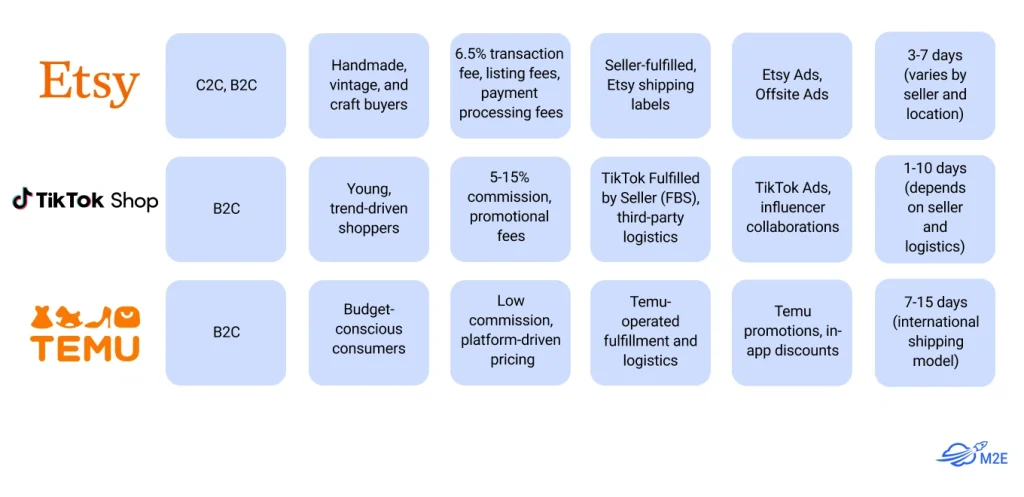
Etsy: The Handmade and Vintage Hub
Etsy is designed for independent creators, artisans, and vintage collectors. It supports small businesses by providing a marketplace for unique, handcrafted, or custom-made products.
How It Works:
- Key Model – Unlike traditional e-commerce platforms, Etsy is a niche marketplace specializing in handmade, vintage, and craft supplies. Each seller manages their shop, but all listings appear in a shared product catalog where buyers browse by category or search results.
- Store Creation – Sellers create an Etsy shop with custom branding, including a shop banner, profile, and policies. Etsy allows customization of storefront aesthetics, product categories, and shop announcements to enhance brand identity.
- Custom and Handmade Focus – Etsy is known for handmade, vintage (20+ years old), and craft supply products. Sellers must meet Etsy’s authenticity guidelines, ensuring that items are either handmade, designed by the seller but manufactured ethically, or vintage. Mass-produced goods not meeting these criteria may be removed.
- Etsy Categories & Special Features – Sellers can offer custom orders, personalization fields, and made-to-order items. This makes it a go-to platform for buyers looking for one-of-a-kind gifts.
- Marketing and Community Engagement – Etsy provides built-in marketing tools, including Etsy Ads (pay-per-click advertising), social media sharing, and email marketing to drive traffic. The platform also promotes high-quality listings in Etsy-curated sections and seasonal campaigns.
- Order Processing and Fulfillment – Unlike Amazon or Walmart, Etsy sellers handle their fulfillment, often including custom packaging, gift wrapping, and handwritten notes to enhance the buyer experience. Some sellers use Etsy’s shipping labels for discounted rates.
- Buyer-Seller Interaction – Etsy emphasizes direct communication, allowing customers to request customizations, color choices, engravings, or made-to-order designs. This personalization feature makes Etsy popular for custom gifts and wedding-related purchases.
- Etsy Star Seller Program – Etsy rewards top-performing sellers with the Star Seller Badge based on fast response times, high ratings, and timely shipping. This boosts trust and visibility in search rankings.
TikTok Shop: The Social Commerce Revolution
TikTok Shop integrates e-commerce with social media, allowing creators and brands to sell directly through short videos and livestreams. Read this blog if you are concerned about TikTok Shop replacing the most popular marketplaces, and remember to check the key considerations for sellers.
How It Works:
- Key Model – Unlike Amazon or eBay, TikTok Shop is content-driven, where sellers, influencers, and brands promote products through short-form videos and livestreams. The marketplace is integrated into the social media platform, meaning product discovery happens organically through entertainment and engagement.
- Livestream Selling – One of TikTok Shop’s most powerful features is real-time shopping via livestreams, where sellers demonstrate products, answer questions, and offer limited-time deals. The algorithm prioritizes engaging live streams, boosting visibility for trending products.
- Shoppable Videos & Product Tags – Sellers and influencers can embed product links directly in their videos, allowing viewers to purchase without leaving the app. TikTok’s interactive shopping experience encourages impulse buying.
- In-App Checkout & Payment Processing – Unlike platforms redirecting buyers to external websites, TikTok Shop enables seamless in-app purchases with integrated payment processing. This frictionless shopping experience increases conversion rates.
- AI-Driven Recommendations & For You Page (FYP) Exposure – TikTok’s algorithm automatically promotes trending products based on engagement, interactions, and shopping behavior. Products that perform well in short videos and live streams get boosted on the For You Page (FYP), maximizing organic reach.
- TikTok Shop Logistics (TSL) & Fulfillment Options – Sellers can either self-fulfill orders or use TikTok Shop Logistics (TSL), where TikTok manages warehousing, packaging, and shipping for faster deliveries. Some regions offer same-day and next-day delivery services for high-performing sellers.
- Affiliate & Influencer Marketing – Unlike Amazon or eBay, TikTok Shop relies heavily on influencer marketing, where creators collaborate with brands to showcase products. The Affiliate Program allows sellers to connect with TikTok influencers who earn commissions on each sale.
Influencer marketing has become a crucial component in driving product visibility and sales, particularly on platforms like TikTok. Brands can benefit from the authentic engagement influencers bring to the table, helping to build trust and reach a wider audience. Agencies like theKollab specialize in influencer marketing, offering expertise in managing collaborations, ensuring that brands can effectively connect with the right creators to amplify their campaigns. - Flash Sales & Limited-Time Discounts – TikTok Shop frequently runs promotional events, such as Super Brand Days, Double 11, and Black Friday deals, offering significant discounts that boost impulse purchases.
If you sell with Shopify, BigCommerce, Ecwid, or WooCommerce, you can link your store to TikTok Shop for business with M2E Multichannel Connect. For those who use Magento (Adobe Commerce), M2E developers provide M2E TikTok Shop Connect.
Temu: The Budget-Friendly Marketplace
Temu is an ultra-low-cost online marketplace focused on affordable products.
How It Works:
- Price Adjustment Policy – Temu offers a price adjustment if the exact item (same size, color, and seller) is discounted within 30 days of payment in the same country or region. Promotional or unavailable items may not qualify.
- Discounted Pricing – Temu’s often offering products at a fraction of Amazon or Walmart prices. The platform uses discount strategies and flash sales to attract budget-conscious shoppers.
If you have a Magento store, you can scale your business with Magento Temu integration by M2E Pro developers.
If you have a Magento store, you can scale your business with Magento Temu integration by M2E Pro developers.
Conclusion: Choosing the Right Marketplace
Each shared marketplace has unique advantages, but managing them separately is challenging. M2E Cloud centralizes product listings, inventory, and orders in one place, ensuring seamless sync across different platforms.