

Refurbished Electronics across Europe is now tied to sustainability and smart value, and marketplaces have backed that shift with real infrastructure: clear grading tiers, defined testing and data-wipe expectations, standard return and warranty rules, and buyer protection that lowers fear at checkout.
Europe’s market for refurbished electronics has expanded rapidly in recent years. It’s forecasted to reach as high as $225 billion by 2031. Industry studies estimate 15-20% yearly growth in the refurbished sector, driven by a “silent revolution” in retail towards the circular economy. This explosive growth means refurbished tech is no longer a niche – it’s becoming an essential mainstream segment of the electronics market.
Why Refurbished Electronics are booming in the EU:
- Buyers can save an average of 30-50% (and in some cases up to 70%) compared to buying new devices.
- Europeans are becoming increasingly environmentally conscious. Buying refurbished devices extends the life of a device, directly reducing e-waste and the carbon footprint of manufacturing new gadgets.
- The refurbishing process has become highly professional. Devices are now thoroughly tested, repaired, cleaned and often come with warranties comparable to new products.
- Thanks to these trends, the use of refurbished electronics is at an all-time high. What started as a cost-saving tactic is now a conscious consumer choice that supports the circular economy.
EU Sustainability Initiatives and New Regulations Sellers Should Know
The EU’s political landscape has strongly influenced the rise of refurbished electronics. European rules and initiatives focused on sustainability and consumer rights make it easier and more attractive to repair, reuse and resell devices. Key developments include:
Right to Repair and Ecodesign
The EU has introduced “right to repair” measures to extend product life cycles. For example, new eco design rules for smartphones and tablets come into force from June 2025, requiring devices to be more durable and repairable. Such rules empower independent repairers and consumers, making repairs more viable at scale.
Digital Product Passports
Expected that in 2026, the EU will gradually introduce digital product passports (DPFs) for certain product categories. Over time, this should improve traceability of materials and repair history, which helps refurbished sellers prove what was done to a device.
General Product Safety & WEEE Compliance
GPSR strengthens general product safety expectations and traceability. In addition, EU legislation on e-waste (WEEE Directive) also applies: if you reintroduce electronics onto the market, you must operate return and recycling programmes, register in each country to comply with e-waste requirements and ensure that the product is properly labelled as WEEE.
Transparency and Labelling
To protect consumers, EU legislation now requires clear disclosure of product remanufacturing information. Sellers must inform buyers that a device has been remanufactured or repaired and provide detailed information on the extent of the remanufacturing or condition assessment.
Cross-border Obligations
Sellers must maintain the legal “product” status of devices throughout their transport and storage, keeping records of their functionality and remanufacturing to avoid them being considered e-waste. Failure to comply with any of these rules can result in severe penalties – from large fines and product recalls to sales bans or delistings on major markets.
Warranty
EU consumer sales rules set a legal guarantee framework. For second-hand goods, many countries allow you and the consumer to agree on a shorter liability period, but not below 1 year. Marketplaces also expect clear warranty and returns terms. If your warranty policy is vague, buyers assume risk and conversion drops.
Top Refurbished Electronics Marketplaces in Europe
With the EU compliance basics out of the way, the real question is practical: where do refurbished electronics actually sell well, with clear condition rules, strong buyer trust, and fees that still leave a margin. Below is a shortlist of marketplaces where you can sell refurbished electronics.
Amazon (Amazon Renewed)


This marketplace already has strong buyer trust in Europe, so Renewed can feel safer than “used” listings with a vague condition claim. Amazon treats Renewed like a controlled quality program, not a loose label.
Getting started has two steps. First, you register as an Amazon seller (if you aren’t one yet). Then you apply to Amazon Renewed and qualify for the program. After Amazon approves you, you can start creating Renewed listings through Amazon’s tools. But approval is not a free pass. Some ASINs can still be restricted, and you may need separate brand or category approval through Seller Support.
Renewed in Europe is built around a “like-new” quality bar. Amazon expects each unit to be inspected, repaired (if needed), cleaned, and tested. They also spell out what “like new” means in practice: no visible cosmetic damage at 30 cm, no dead or stuck pixels, and battery capacity above 80% where applicable. Devices must be factory reset, data-sanitized, and (where applicable) fully unlocked and upgradable to the latest OEM-supported firmware.
Trust is backed by the Amazon Renewed Guarantee in Europe, with coverage for one year from customer receipt (replacement or refund if the issue is not resolved). That boosts conversion, but it also makes returns and replacement stock part of your unit economics.
Operationally, the “hard part” is unit-level discipline. For phones, Amazon calls out diagnostic testing, IMEI checks to avoid stolen/blacklisted units, and IMEI record retention for at least 120 days to support audits. This pushes you into a real workflow for testing, labelling, recordkeeping, and return verification.
Fulfillment works the usual Amazon way: ship yourself (merchant-fulfilled) or use FBA.
Fees for Selling on Amazon Renewed
- The Professional plan. $39.99 per month + category referral fees and FBA fees if you use fulfillment.
- Referral fee. 8% for categories like Consumer Electronics, Computers, and Video Game Consoles (exact fee depends on the product category you map the SKU to)
- Extra fee for Amazon Renewed. 2% on Renewed Mobile Phone Devices and 1% on all other Renewed products
- Renewed pricing rule. At least 5% below the equivalent new offer.
Amazon Renewed Approval and Quality Requirements
- Approval for Amazon Renewed, plus invoice proof of refurbished supply and product/packaging sample images during onboarding.
- Strong account health, including ODR at or below 0.8% (where applicable).
- Repeatable refurbishment process: inspect, test, clean, repair (if needed) to a like-new bar (no dead pixels, battery >80% where applicable).
- Factory reset and data sanitization.
- Phone controls: diagnostic test, IMEI check, and IMEI records kept for at least 120 days.
- Listing rules: original brand only (no seller branding), no bundles, warranty language aligned to Renewed, include the Renewed program insert.
- Merchant-fulfilled sellers: opt into prepaid return labels to keep Renewed eligibility.
eBay (eBay Refurbished)
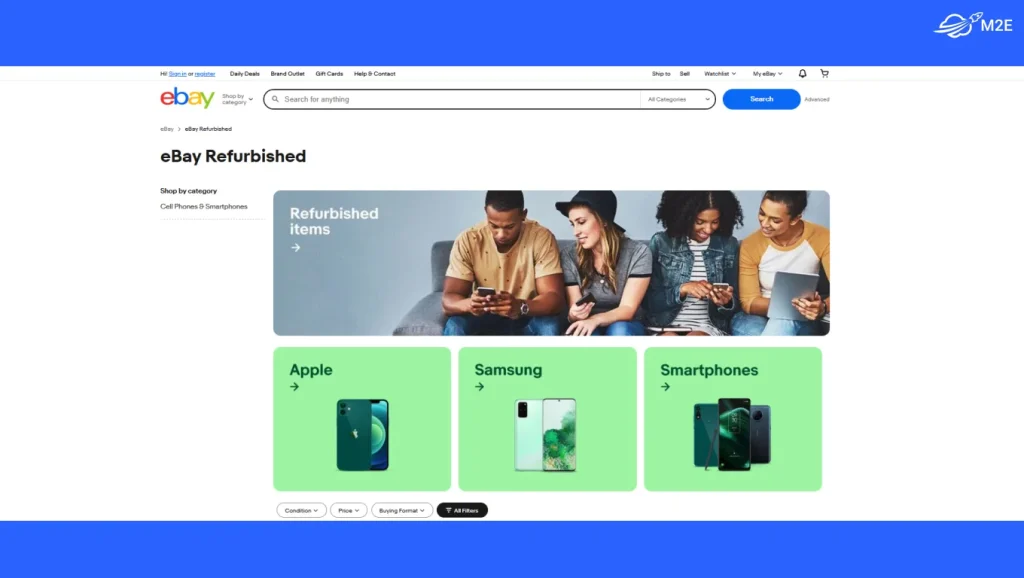
eBay works for refurbished electronics in Europe because buyers shop with filters. They care about two signals: a clear condition grade and a safety net if something goes wrong. eBay gives them both, so refurbished does not look like a gamble.
Getting started is easy on the account side and gated on the refurbished side. You can open a business seller account and sell immediately, but the refurbished condition tiers are not always available by default. On many European eBay sites, you need approval to use the refurbished labels. If you do not have access, you can still sell the same items, but you list them under regular used conditions.
eBay Refurbished is country-local. Germany uses four refurbished tiers (Zertifiziert, Hervorragend, Sehr gut, Gut). France and Italy also use four tiers with local names. Spain and the Netherlands heavily emphasize “Certified Refurbished” style offers. The structure is the same, but the labels and seller promises vary by country.
Trust is backed by eBay’s buyer protection. That boosts conversion, but it also means your grading and your proof need to be tight. If your “Excellent” starts slipping into “Good” in real life, you will pay for it through “not as described” claims and return costs.
Operationally, eBay is simple in concept and unforgiving in execution. You need a repeatable unit workflow: test, clean, wipe data, grade, pack, ship, then handle returns without losing track of serialized units.
eBay Fee Structure for Refurbished Electronics
- Store subscription. Starter plan from $4.95/month
- Final value fee (most Consumer Electronics categories). 12.7% on the total amount of the sale up to $2,500 per item, plus 2.35% on the portion over $2,500.
- Per-order fee. Charged per order, the amount depends on your Store plan.
- Fee-based. The final value fee is calculated on the total amount of the sale.
Requirements for Selling Refurbished Electronics on eBay
- Business seller account and verification.
- Approval to use refurbished condition tiers.
- Condition grading must match eBay’s published definitions for that site.
- Strong service performance to stay eligible (low “not as described”, low “not received”, high positive feedback, depending on site rules).
- A clear seller promise on refurbished listings that many sites expect, often free shipping, at least 30-day returns, and a defined warranty period (France and Italy are explicit about 12 months or 1 year, and some sites require tracked shipping).
- “Certified” tier proof where required: manufacturer or manufacturer-authorized refurbishment, not just “tested by seller”.
- A repeatable inspection and testing process so returns do not become your growth ceiling.
Kaufland Global Marketplace (Used & Refurbished Electronics)

Kaufland is one of the most practical Europe-first options for refurbished electronics because it makes “condition” a real system, not a vague claim. It gives buyers clear labels, and it gives sellers clear rules. That is exactly what refurbished needs to scale.
Kaufland Global Marketplace lets you sell across seven marketplaces – Germany (DE), the Czech Republic (CZ), Slovakia (SK), Poland (PL), Austria (AT), France (FR), and Italy (IT) with one registration, and you manage them from one Seller Portal. You can activate additional country channels after your account is set up, and you can create offers per marketplace when you need different pricing, delivery times, or condition strategies by country. If you’re planning EU expansion, Kaufland is attractive because you can run it as one growth channel across multiple countries, not a separate rollout and ops project for each new market.
The big win for refurbished is how Kaufland defines it. Their product data guidelines spell out refurbished tiers like new, very good, good, and acceptable, including device-specific rules for smartphones, tablets, laptops, and smartwatches. They tie grading to practical expectations (screen and case rules, packaging, accessories), and they set a hard line on battery health: refurbished electronics in those categories require a minimum 85% battery status.
Kaufland is also explicit about eligibility. If you want to sell refurbished products, you’re expected to contact your Account Manager or Seller Support, and you must meet requirements like a documented refurbishment process, the use of diagnostic programs during inspection, and proof of CE marking where required.
Operationally, complexity is moderate to high if you run multi-country. You’ll manage shipping groups, delivery times, and offers per marketplace, and because matching is based on EAN, your product identifiers and condition mapping need to stay clean across storefronts.
What you pay on Kaufland Global Marketplace for a Refurbished Electronics
- Monthly base fee. EUR 39.95/month (Basic), EUR 59.95/month (Plus)
- Commission depends on the category and the country marketplace. States range from 4% to 16%. For “Computers & Consumer Electronics” 7% in DE/AT/CZ/SK/FR/IT, 4% in PL
Kaufland Global Marketplace requirements for selling Refurbished Electronics
- Condition accuracy: your refurbished condition must match Kaufland’s published definitions (including device-specific rules).
- Refurbishment process documentation: You must provide a detailed process description.
- Diagnostics in the workflow: use software and hardware diagnostic programs to verify functionality.
- CE compliance where required: provide proof of CE marking for refurbished products.
- Battery rule for key device categories: minimum 85% battery status for refurbished tiers on smartphones/tablets/laptops/smartwatches.
- Onboarding basics: company and tax info, plus required documents based on your legal form (IDs, register extract, ownership info).
OTTO Market (No Dedicated Refurbished Electronics Program)

OTTO Market is built for a classic German retail shopping experience. That is good for trust, but it also means OTTO runs the marketplace with stricter operational rules than “anything goes” platforms. You sell on otto.de as the merchant of record, and the same item can be offered by multiple sellers, so clean product data and stable service matter.
Getting started follows a standard onboarding path: OTTO checks whether your assortment fits their product groups, then you integrate and start listing. OTTO’s public seller info makes one thing clear upfront: there is a fixed monthly cost, so you should treat OTTO as a committed Germany channel, not a casual test.
For refurbished electronics, OTTO is not “refurbished-first” in the way Amazon Renewed is. OTTO does not publicly position a dedicated refurbished badge with grading tiers. So buyer trust depends on what you deliver operationally: consistent condition definitions, reliable returns handling, and clear warranty terms in your own offer messaging.
Operationally, OTTO is Germany-centric. OTTO requires German-speaking customer service and a German legal entity based in Germany (in their marketplace materials, this is called out as a mandatory requirement). On logistics, OTTO states you ship from a warehouse in Germany or the EU, and you accept returns in a warehouse in Germany or selected EU countries. Their checklist also specifies supported carriers for parcel shipping and return flows.
OTTO Market Pricing
- Monthly basic fee. EUR 99.90
- Commission. Category-based (by product group). Electrical Appliances is listed at 10%.
OTTO Market Eligibility and Operations Requirements for Sellers
- German legal entity based in Germany and German-speaking customer service (mandatory).
- Ship from a warehouse in Germany or the EU.
- Accept returns in Germany or selected EU countries.
- Use supported carriers for shipping and returns (per OTTO checklist).
- Maintain clean product identifiers and mandatory legal attributes in product data (OTTO enforces validation rules).
MediaMarktSaturn Marketplace (MediaMarkt Refurbished)

MediaMarktSaturn is a strong option in Europe if you sell refurbished electronics and you want buyers who already trust an electronics-first retail brand. You are selling inside a retail environment where customers expect clear specs, clean product pages, and “it just works” service.
Getting started follows a standard marketplace flow: you create a shop in the marketplace backend, complete verification (including payment provider checks), upload products, and then go live. The key point for refurbished is simple: this marketplace rewards operational consistency more than aggressive listing volume.
Trust for refurbished comes from how the offer is presented. On MediaMarkt and Saturn storefronts, refurbished items commonly show clear condition labels (for example, “Exzellent”, “Sehr gut”, “Gut”), and some listings also show battery minimums. That reduces “not as described” friction, but only if your grading is strict and repeatable.
Operationally, treat this as a structured, catalogue-first marketplace. MediaMarktSaturn’s own materials push sellers toward integrations and bulk product upload workflows (instead of manual one-by-one work). Internally, their marketplace roles explicitly reference Mirakl, which usually translates into: strict attribute completeness, predictable feed logic, and disciplined offer management.
In terms of geographic footprint, MediaMarktSaturn reports that its marketplace is available in eight countries (after a Turkey launch in October), and it also states plans to roll out to Hungary and Switzerland.
Fees That Matter for MediaMarktSaturn Sellers
- Monthly fee: 39 EUR net per month
- Commission: category-based (numbers depend on country/contract conditions).
MediaMarktSaturn Marketplace Onboarding and Catalogue Compliance Requirements
- You create a shop in the marketplace back-end, add banking details, and complete verification with their payment service provider as part of onboarding.
- A consistent grading workflow that matches the storefront condition labels you use (and you must be able to defend it when returns happen).
- Feed-ready product data and a bulk upload or API-driven process, because the marketplace is designed around structured uploads and attribute completeness.
- The ability to operate at “retail expectations” level: fast dispatch, clean packaging, and predictable returns handling (refurbished fails fast when service slips).
- Country-by-country commercial terms and operational setup as you expand across storefronts, since the marketplace scales by country.
- Expect GTIN/EAN and category-specific attributes to matter for creating or updating catalogue content. This is a “catalogue-first” marketplace experience.
- Fees, commissions, and some operational settings are defined per country agreement (example: Netherlands monthly fee and category commissions managed in Mirakl).
Manage Refurbished Sales Across Marketplaces with M2E Cloud
One practical way to reduce multichannel friction is to run everything through one control hub instead of managing each marketplace as a separate world. M2E Cloud’s Multichannel Connect is built for that. It lets you handle listings, inventory updates, and orders from one interface, so Amazon, eBay, Kaufland and other channels feel like one system, not five different workflows.
This matters even more for refurbished electronics because you sell units by unit. Each device has its own condition grade, test results, identifiers, and return risk. If your data slips, you pay for it fast: returns go up, “not as described” claims spike, and account health takes the hit. When you add more marketplaces, the pressure multiplies because every platform has its own set of rules and customer promises.
How M2E keeps Refurbished Listings, Stock, and Orders Consistent
- Cleaner listings with fewer failures. Each marketplace has its own required fields, category specifics, and formatting rules. M2E supports structured listing workflows and helps you prepare data the way the channel expects. The Listing Validator Assistant checks listings before submission and flags missing or invalid fields early, so you fix issues before they turn into failed uploads.
- EU safety and GPSR-ready data. If you sell to EU buyers, GPSR can require extra product safety and traceability details in your listings and seller information. M2E helps you keep those required fields consistent across marketplaces by reusing structured listing data, mappings, and templates per channel. This reduces last-minute fixes and lowers the risk of listings being rejected because a required GPSR-related field is missing or formatted incorrectly.
- Unit-safe inventory control. Refurbished stock is limited and unit-sensitive. One wrong quantity update can cause overselling, cancellations, and account damage. M2E keeps inventory aligned across connected channels in real time, so when a unit sells on one marketplace, it immediately goes out of stock everywhere else.
- One order workflow, tracking sync included. Orders from multiple channels land in one queue instead of being spread across dashboards. When you ship, tracking and order status updates sync back to the correct marketplace automatically, which cuts manual work and reduces delivery mistakes.
- Performance visibility across channels. As volume grows, you need to spot issues before they become policy violations. With M2E Analytics, you can monitor key signals in one place, like stockouts, cancellations, listing failures, and delivery delays.
- A single system as you scale. The biggest advantage is reuse. You don’t rebuild the same process for every marketplace. Just reuse mappings, policies, and workflows across channels, so adding a new marketplace feels like expansion, not a full operational reset.


Conclusion
A few years ago, used electronics felt risky: hidden defects, weak batteries, missing accessories, and painful returns. Today, refurbished sells because marketplaces added trust infrastructure: clear condition tiers, testing rules, warranty and returns standards, and buyer protection.
Those mechanisms moved from a niche secondary market to a normal e-commerce category. But each marketplace runs its own refurbished playbook, so the best channel is the one that matches your operational maturity, not the loudest brand.
As you scale, the hard part is keeping unit-level inventory, IDs, condition data, listings, and orders consistent across channels. M2E Multichannel Connect helps you run that in one workflow, so expansion doesn’t mean rebuilding your process every time.


