Every time you go to the supermarket or restaurant, borrow a book from the library or connect to Wi-Fi, rent a car or use public transport, you are interacting with barcodes. They’re literally everywhere, whether we notice them or not.
The barcode industry is undergoing its biggest transformation in decades. Traditional 1D barcodes, which have supported retail for over 70 years, are gradually being replaced by 2D technologies that can contain significantly more product information. This shift affects every e-commerce seller, especially those who work with large marketplaces.
So why are barcodes so popular? Are they so essential to run an online store? Where to get them, and what format is better? We’ll cover these questions in this blog post.
What is a barcode?
A barcode is a scanner-readable label containing encrypted information about a product. Barcodes are designed like fingerprints. They have a unique pattern that identifies the product in the store.
As a rule, barcodes are used directly at the point of sale, in inventory management systems, or in warehouses to quickly distinguish a product and determine its price, material, asset, etc.
Types of barcodes
There are two types of barcodes: 1D (one-dimensional) and 2D (two-dimensional). However, industries now require more product data, which is driving a historic transition from 1D to 2D technology.
One-dimensional (1D) barcodes
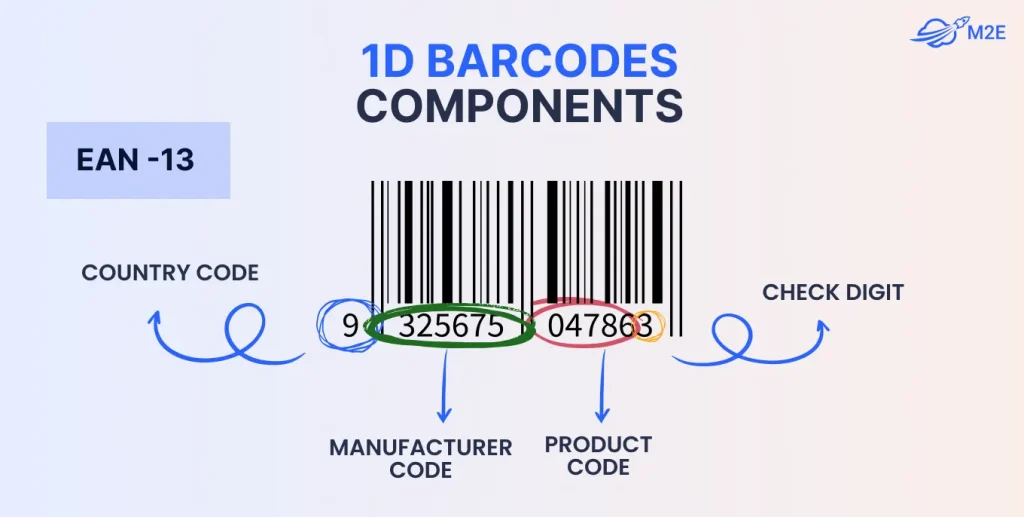
Traditional 1D barcodes look like lines of black and white stripes with codes underneath them. You may have seen them on product packaging, book covers (ISBN codes), shipping labels, etc. A 1D barcode (such as the familiar UPC or EAN code) contains a string of numbers. During scanning, these numbers are searched for in a database and provide information about the product name, brand, or price. The barcode itself only contains the product identifier (GTIN). All other information is stored in internal systems.
The most common 1D barcodes formats are:
- Code 39 or Code 3 of 9. It is often used in the automotive industry, logistics, and the US Department of Defense. Code 39 can use both symbols and numbers. Despite its similarity to Code 128, it is characterized by a relatively low density.
- EAN (European Article Number). A standard barcode used worldwide for retail goods. Their main advantage is their flexibility of use. You may have encountered EAN-13, which is often used to encode large amounts of data, or EAN-8, which is ideal for identifying very small products.
- UPC (Universal Product Code). You can often find it on consumer goods around the world, mainly in the United States. This barcode variant uses the same coding system as EAN-13, but does not show the leading zero. This is the country code indicator for North America. The UPC-A variant encodes twelve digits, while UPC-E encodes six digits.
- Code 128. These barcodes are compact and highly dense. They are often used in logistics and transportation for ordering and distribution. These barcodes can store a wide variety of information by supporting any ASCII 128 character set. This makes them ideal for identifying shipped or packaged containers and items.
Two-dimensional (2D) barcodes

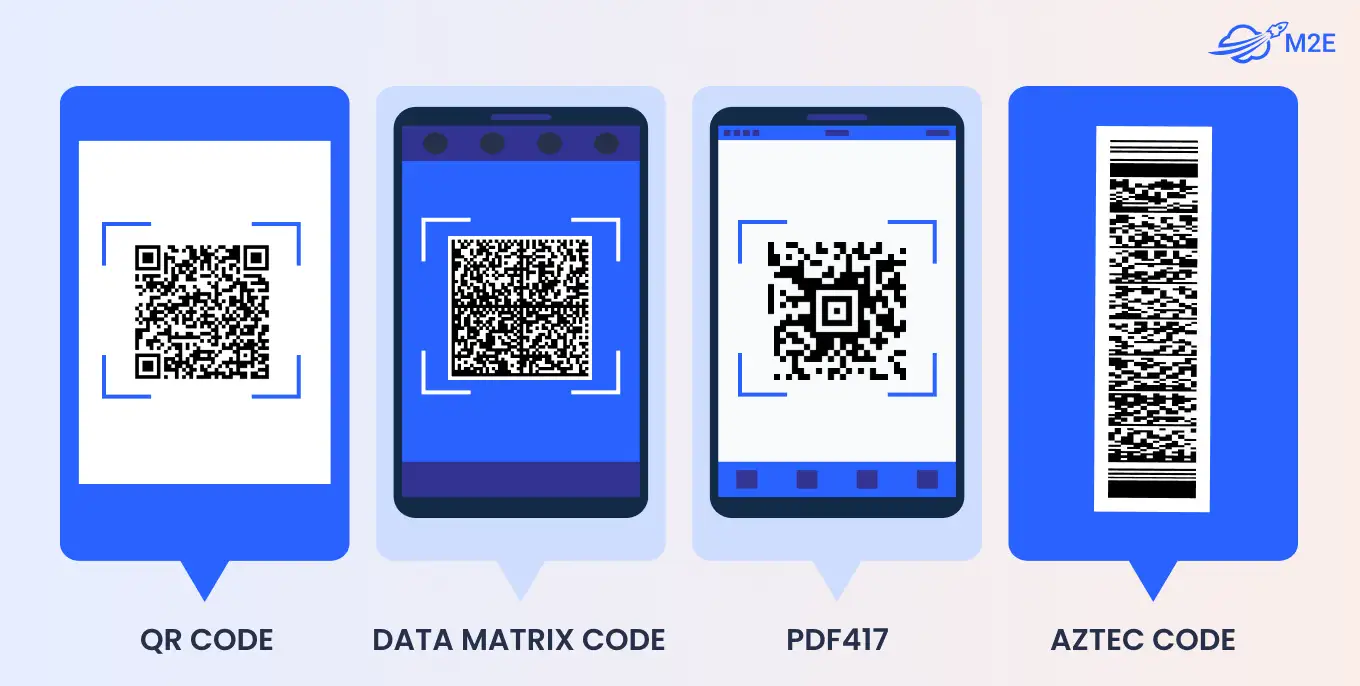
2D barcodes differ from 1D barcodes in that they contain more data directly in the code itself. They consist of patterns of squares, dots, or other shapes, often arranged in a square grid. You are very familiar with 2D barcodes. A notable example is the QR code (Quick Response Code). When you scan a QR code with your smartphone, it can take you to a website, display text, or even authenticate your login. Because QR codes are open and widely supported, businesses can easily generate QR codes to connect physical products with digital content such as instructions, traceability data, or marketing pages without relying on proprietary systems. That’s why 2D codes are used for everything from mobile payments to product packaging.
Unlike 1D barcodes, 2D barcodes can store:
- Assembly instructions, recipe ideas, video tutorials, and product registration
- GTIN, SKU, brand information
- Lot and batch numbers, production dates, and expiration dates
- Serial numbers, digital signatures
- Links to advertising campaigns, loyalty program registration
- Carbon footprint, recycling instructions, certification of origin
- Allergen warnings, ingredient lists, safety data
The most common 2D barcodes formats are:
- QR Code (Quick Response). They support byte/binary, numeric, and alphanumeric data modes. You can easily generate your own code, as they are publicly available and free to use. QR codes are most commonly found in marketing, advertising, magazines, tracking, and payments.
- Data Matrix Code. Data Matrix is often used to mark goods, documents, or small items. They are recommended by the US Electronic Industry Alliance (EIA) for marking small electronic components. They are ideal for small products in logistics operations due to their small size. Data Matrix codes are easy to read, highly fault-tolerant, and offer high data density.
- PDF417. These codes can store huge amounts of data, over 1.1 kilobytes. That’s why they’re great for all sorts of stuff, from transportation and inventory management to ID cards and boarding passes. They’re also free and available for everyone to use.
- Aztec Code. These codes are most commonly used in the transport industry for boarding passes or tickets. Despite their small size and compactness, they can store huge amounts of data. In addition, they have error correction and prevent scanning errors.
Many industries and retailers are starting to migrate to 2D QR codes. These next-generation barcodes use the GS1 Digital Link standard to embed the product’s GTIN (Global Trade Item Number) into a web URL. This way, a single scan can provide a wealth of information about the product.
The traditional 1D UPC/EAN increasingly struggles to meet modern requirements for transparency, supply chain tracking, or product authentication.
Sunrise 2027: The industry transition deadline
To ensure this transition, retailers have launched the Sunrise 2027 initiative. It aims to upgrade all POS systems with scanners that can read both traditional 1D barcodes and modern 2D barcodes.
The idea is that a single 2D code on a product will serve both consumers and cashiers. Shoppers will be able to scan it with their phones to instantly get product information, and cashiers will be able to scan it at the POS system checkout to find out the price. In this way, a single symbol can make retail transparent and efficient.
This transition will also provide retailers with a number of competitive advantages. These include better product authentication, more active customer engagement, and supply chain transparency.
Barcodes For Marketplaces: Getting Compliant GTINs
If you are just starting out in e-commerce, you can create simple barcodes yourself. There are many tools available for creating 2D codes yourself. As your business grows, you can invest in a specialized system for generating and printing barcodes, as well as a database for managing your product codes. This way, you can assign and track your own SKUs or internal barcodes for all your products.
However, if you plan to sell on large marketplaces such as eBay, Amazon, or Walmart, you will need official, globally unique barcodes. To obtain these identifiers, you need to register with GS1, which issues standard GTINs (UPC/EAN numbers). Depending on the number of codes per product, GS1 will charge a corresponding amount. In addition, you will need to pay an initial membership fee and an annual fee to renew your company prefix. In return, you will receive authentic GTIN codes (UPC, EAN, etc.). They remain the global standard and can be used in both traditional 1D barcodes and new 2D codes.
Here are the latest marketplace barcode requirements and policies.
Amazon
Amazon requires the use of valid GS1 GTINs (UPC/EAN) for most new products. Unregistered “resold” codes are often blocked during brand verification. Amazon actively checks whether the GS1 company prefix matches the brand owner. If you use third-party or purchased codes from unofficial sources, be prepared for your listing to be suspended. Amazon clearly warns that listings will be removed if the barcode provided is not found in the official GS1 database. Their systems detect and block invalid GTINs during listing or brand registry verification.
If you use Fulfilled by Amazon (FBA), each unit must also carry a scannable label. You can either keep using the GS1 manufacturer barcode (UPC/EAN) or switch to an Amazon-specific barcode called FNSKU. Using the manufacturer’s barcode means your inventory is pooled with other sellers’ stock for the same GTIN. Using FNSKU keeps your units separate, but it requires Amazon-specific labels.
However, certain products are exempt from GTIN requirements. These include private-label products and handmade items.
Walmart
For most product-based suppliers, Walmart requires a GS1 Company Prefix. Walmart uses GTINs to manage product catalogs, track inventory in fulfillment centers, and ensure customer data accuracy.
You must provide your GS1 company prefix when applying for supplier status. This is required to prove that your products have legitimate UPC barcodes. Walmart mentions in its documentation that this prefix guarantees unique identification in its systems. It also involves an annual renewal fee based on the number of products.
eBay
eBay considers product identifiers to be an essential part of a listing. Product identifiers (GTIN, UPC, EAN, ISBN, MPN) are mandatory for most categories. You must only use an identifier that accurately matches the product you are selling. Otherwise, your product may be blocked, removed, or not renewed.
Listings with correct identifiers also rank better in eBay search and external search engines such as Google Shopping. However, eBay may allow exceptions for used or collectible items such as antiques, vintage, custom-made, or unique items. In this case, you may not have an identifier and can select “Not applicable.”
Kaufland Global Marketplace
Kaufland Global Marketplace is a European marketplace that requires a valid EAN (EAN-13 GTIN) for each product. The platform recommends that sellers purchase GTINs only from their local GS1 organization. This will ensure uniqueness and proper brand ownership.
Kaufland uses EAN as the primary key for its catalog and compares products based on this number. When you add an offer, the process is similar to Amazon: first, you enter the EAN, manufacturer, or product name in the search field. If the product already exists in the Kaufland database, you simply add your offer to that product and set the price, availability, and delivery terms. If the product is not found, you must create a new product record by selecting the sales channel, entering the EAN, and filling in all the required attributes step by step before publishing.
Product matching in their catalog is based on EAN. That is why using official GS1 EANs is critical. Random or reused codes disrupt matching, can block adaptation, and make it impossible to correctly list products or scale the catalog in different countries. Therefore, be prepared to obtain the necessary GTINs in advance.
OTTO Market
OTTO Market considers EAN to be a mandatory attribute for most new products. It groups offers by identical EANs and links them to its internal MOIN (OTTO product identifier).
If the EAN is already known in OTTO’s systems, your SKU is linked to an existing product and receives a MOIN. You only manage the price, availability, and delivery terms. If the EAN is not yet known, your data is used to create a new product record and a new MOIN. You must provide all mandatory attributes, brand information, images, and legal data.
It is important to use official GS1 GTINs, as OTTO groups offer from various sellers by EAN. Random or reused barcodes can cause registration errors or your offer to be added to the wrong product in the OTTO catalog.
TikTok Shop
TikTok Shop also requires its users to comply with GS1 standards. For most product categories, you need to enter a GS1 GTIN (UPC/EAN) when adding a new product listing. There are some exceptions (for example, custom-made or handmade items may not require a GTIN), but in general, if your product has a barcode, you must provide it.
TikTok Shop uses these codes to power its product database and ensure consistency. Sellers must obtain valid GTINs before listing or apply for an exemption if they are eligible.
Temu
As of 2025, Temu’s public documentation regarding GTIN requirements is unclear. They have fields for product identifiers (UPC, etc.) when listing products, but do not explicitly state that a GS1 barcode is required for each product. The seller onboarding and product upload process focuses on business information, tax settings, product names, images, attributes, etc.
In practice, many Temu sellers use internal SKUs or manufacturer barcodes instead of GS1 identifiers. GTINs (EAN/UPC) are accepted where available, but policies may vary depending on region and category. If you plan to build a long-term brand or sell the same catalog on Amazon, OTTO, or Kaufland, it is safer to assign GS1 GTINs. Then follow the current Temu Seller Center guidelines. This will allow you to see whether the GTIN field is mandatory, optional, or ignored for your specific category.
Shein
Shein’s policy on barcodes on its marketplace is similarly opaque. Shein is primarily known as a retailer of fashion apparel. It also allows third-party sellers to use its marketplace model (Shein Marketplace). Like Temu, Shein does not currently publicly require GTINs for all products.
Many clothing items are private-label or unbranded fashion items that have never had barcodes. Sellers on the Shein platform may not need to provide a UPC/EAN for every listing. Most rely on their own SKUs. However, sellers report mixed experiences-some categories require GTINs, while others do not.
But note that using GS1 GTINs is still a cleaner strategy. You can launch on SHEIN with SKUs and internal barcodes, but GS1 identifiers ensure consistency in your data model and tracking of your own inventory.
M2E Multichannel Connect helps you list products on marketplaces in line with each platform’s requirements, from GTINs to category specifics. It also centralizes inventory and order management across all connected channels.
If you have any questions, reach out to our team.
Benefits of Using Barcodes

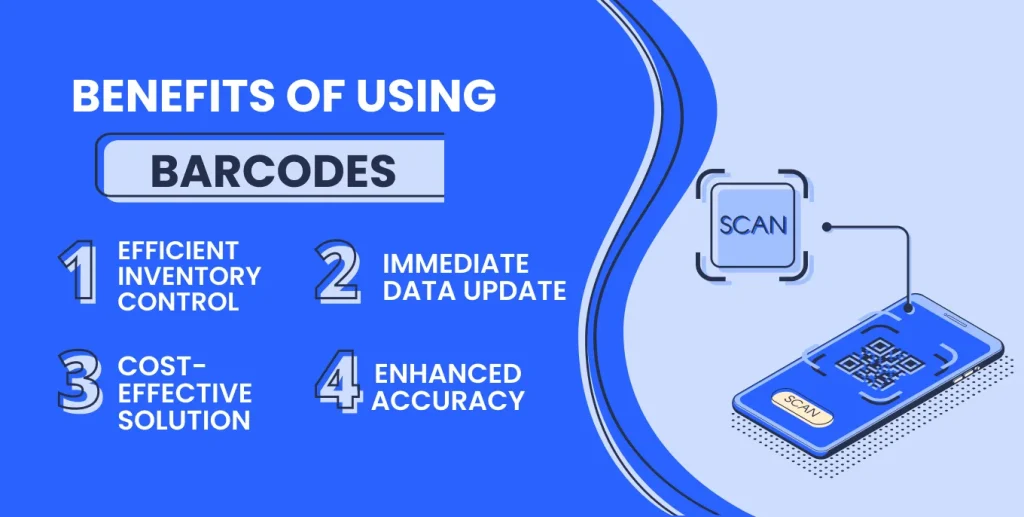
For over 70 years, barcodes have been the primary tool for speeding up sales transactions and improving inventory management. They are an integral part of tracking prices, shipments, or returns. In addition, barcodes offer other benefits to businesses:
- Scanning a barcode to enter data means far fewer errors than entering numbers manually. This allows you to reduce paperwork and ensure the accuracy of information in your system.
- Barcodes make data processing extremely fast. In just a few seconds, you can update inventory levels, record sales, or update inventory data. And all this in real time.
- Barcodes are also an effective way to identify and track goods throughout the supply chain. With them, you can easily find out information about the movement of goods, track shipments, or manage returns. This significantly reduces your time and eliminates many errors and the human factor.
- Implementing barcodes in your business is relatively inexpensive and simple. You don’t need advanced technical knowledge or extensive training to get started. Generating and printing basic barcodes is very inexpensive-there are even free online generators available. In return, you save time and resources, gain access to all marketplaces, and reduce errors.
Wrapping up
No matter where you sell, barcodes are an essential tool for accurately storing and tracking product data. They speed up operations, reduce errors, and now, in 2025, they are evolving to contain even more information.
Traditional 1D barcodes laid the foundation for global trade, and new 2D barcodes (QR codes with a GS1 digital link) meet today’s need for greater transparency and consumer engagement. This will allow you to transition smoothly to Sunrise 2027 and grow your business with both customers and partners.
Start with GS1 registration. Get your barcodes right. Everything else in your marketplace strategy depends on it.
Frequently Asked Questions (FAQ)
1. Do I need different GTINs for different marketplaces?
No. One of the key benefits of GTINs is universal recognition. The same GTIN should be used across all sales channels:
- Amazon
- Walmart
- eBay
- Your own website
- Brick-and-mortar retail
Using different GTINs for the same product across channels creates inventory chaos and violates GS1 standards. Exception: Platform-specific identifiers like Amazon’s FNSKU (for FBA) or internal SKUs are separate from your GTIN and used alongside it.
2. What’s the difference between a barcode and a GTIN?
- GTIN (Global Trade Item Number): The number itself (e.g., 012345678905)
- Barcode: The visual representation of that number (the scannable image)
Think of it this way: your phone number is the GTIN, and the contact card with your name/number printed is the barcode. The GTIN is what identifies your product globally; the barcode is just one way to display it.
3. Can I create my own internal barcodes without GS1?
Yes, for internal use only. If you’re not selling through retail channels or marketplaces, you can use:
- Code 128 or Code 39 symbologies
- Custom SKU-based barcodes
- Free online barcode generators
However, these codes:
- Won’t work on Amazon, Walmart, or retail stores
- Aren’t recognized outside your organization
- Can’t be used for GS1 Digital Link or supply chain traceability
If you plan to sell through any third-party channel, invest in real GTINs from the start.
4. What size should my QR code be for packaging?
GS1 guidelines recommend:
- Minimum size: 10mm x 10mm (0.4″ x 0.4″)
- Recommended size: 15-25mm (0.6″-1″) for reliable smartphone scanning
- Quiet zone: Minimum 4X module width (white border around code)
- Contrast: Black code on white background (or high-contrast alternatives)
Test codes at your planned print size with multiple smartphones before mass production. Smaller codes work but increase scan failure rates.
5. Will my 1D barcodes stop working after 2027?
No. Sunrise 2027 doesn’t eliminate 1D barcodes – it requires retailers to support 2D barcodes. Your existing UPC/EAN codes will continue to function indefinitely. However:
- New products should use 2D codes
- Retailers may prefer or require 2D for new listings
- 1D-only packaging may face operational friction over time
Think of it like the transition from IPv4 to IPv6 – legacy systems coexist during the long transition period.