

A few years ago, refurbished electronic Products grew slowly for one simple reason: buyers saw ‘used’ as a risk. The real device condition was unclear, warranties were inconsistent, and dispute outcomes were unpredictable. Even with a big price gap, many customers still hesitated.
That changed when major marketplaces became the trust broker. They standardized what used to be a chaotic second-hand space and turned refurbished into a controlled commercial format with clear rules and accountability.
Key shifts behind this change:
- clear condition grading (for example, Like New / Very Good / Good) that reduces uncertainty for the buyer;
- buyer protection and predictable return flows;
- standardized warranty commitments that bring refurbished closer to “new” in service level;
- requirements to sell through approved refurbishers, not random resellers.
These mechanisms pushed refurbished electronics beyond a niche secondary market and into a core ecommerce category. Without a marketplace trust layer, the segment would not scale in demand, and it would not be stable enough operationally for serious sellers.
What are Refurbished Gadgets and Electronics?
To start with, refurbished electronics are pre-owned or returned devices that have been professionally restored to a defined functional standard. The term “Refurbished” is often confused with “Used” or “Renewed.” There is a clear terminology here that every seller needs to know.
- Reconditioned – repaired and tested to restore full functionality. In many markets, it implies a deeper fix than “renewed,” but there’s no universal standard. Treat it as “refurbished with heavier work” unless the platform defines it differently.
- Renewed – it may need minimal fixes, cleaning, and repackaging. Some marketplaces use “Renewed” as a branded label (example: Amazon Renewed), which comes with program rules.
- Used – a used device is sold as-is, usually without restoration to a defined quality standard. It may work fine, but it usually has more uncertainty around wear, battery, and hidden defects. Warranties and guarantees are often limited or absent.
- Open-box – has been opened (unsealed) and may have been briefly used, displayed, or returned. It’s usually close to new and often needs only cosmetic checks and verification that all accessories are included. The key is transparency: buyers expect “near-new,” not “repaired.”
Refurbished Electronic Product by Category: What Sellers Must Get Right
- Laptops. Use a fixed QA checklist every time: power and charging, battery health, display (dead pixels and backlight), keyboard and trackpad, Wi Fi, webcam and audio, ports, and storage health. Log the results and the serial number. Be very explicit about what comes in the box. Missing chargers and weak batteries are among the most common return triggers. Cosmetic grading needs to match the photos.
- Smartphones. The process has to be strict: IMEI or serial traceability, verified wipe and factory reset, no activation or carrier locks, and a clear statement of battery health. Returns usually spike when the condition grade feels inflated, the device arrives not fully reset, or the buyer discovers a lock after setup. Include close-up photos of the screen and frame, not only the “hero” shot.
- Desktops and workstations. Match CPU, RAM, storage, and GPU exactly as listed, and stress test for stability and thermals. If the unit is loud under load, say so. Ship it deployment-ready with a clean OS install, drivers set up, and any business software removed.
- Tablets and iPads. Returns are driven by screen condition and account locks. Verify touch performance, screen uniformity, battery, speakers, cameras, and complete a factory reset with no linked accounts. If there are minor screen marks, show them clearly, because tablet buyers notice.
- Monitors and displays. Test for dead pixels, brightness uniformity, and all ports. Transit damage is a major issue, so packaging matters. Always include the stand and the right power cable, and state clearly what is included. If it ships without a stand, say it in the title or at the top of the description.
- Printers and scanners. Do real-world tests, not only power on. Print and scan a test page, check feeding reliability, and note any error codes. Buyers get frustrated when setup takes too long, so include a simple, quick start note and be explicit about included trays, cables, and consumable.
Top 5 Refurbished Electronic Products Marketplaces in America
We’ve rounded up the top 5 marketplaces where you can sell refurbished electronics. They may differ in requirements, standards, or accessibility. So we’ve gone through each one and covered the most important points that every seller should know before starting to sell on a particular platform.
Amazon (Amazon Renewed)


Amazon already has a reputation for being trustworthy, so the Renewed program seems like a safer bet than a typical used listing. The Renewed label helps customers know they’re getting a tested device with clear safeguards. Instead, Amazon strictly enforces the program.
Getting started is a two-step gate. First, you register as an Amazon seller (if you haven’t already). Then you apply to the Amazon Renewed program and meet its qualification bar. Only after approval can you start adding listings through Amazon’s tools. Approval also does not unlock everything. Some ASINs can still be restricted, and standard brand or category gating may require separate approval through Seller Support.
Amazon uses a clear condition model. Renewed items are fully functional and graded as Premium, Excellent, Good, or Acceptable. The promise to the buyer is simple: the device should look and work as it should. Amazon also sets specific expectations for appearance and performance, including no obvious cosmetic damage up close, no dead or stuck pixels on displays, and battery health above 80% where applicable. Devices must be factory reset, and customer data must be fully erased using recognized sanitization standards.
Trust is backed by the Amazon Renewed Guarantee. In the US, most Renewed items can be returned within 90 days for a refund or replacement, while Renewed Premium typically extends that to one year. This protection builds confidence, but it also makes returns part of your cost model.
In terms of operational complexity, Renewed becomes demanding in day-to-day operations because Amazon expects consistency at the unit level. It often depends on the product, but phones add more operational steps. Amazon expects diagnostic testing and a factory reset, and also requires IMEI verification to prevent theft or blacklisting of devices. You also need to keep IMEI verification records for at least 120 days in case of an audit. This is the very requirement that forces you to create a real workflow for testing, labeling, recordkeeping, and return verification.
As for delivery, you ship either Seller Fulfilled (you store and ship) or via FBA (Amazon stores and ships). The operational choice is simple: FBA buys you speed and workload reduction, seller-fulfilled buys you control and sometimes better unit economics on bulky or fragile items.
Fees for Selling on Amazon Renewed
- The Professional plan. $39.99 per month + category referral fees and FBA fees if you use fulfillment.
- Referral fee. 8% for categories like Consumer Electronics, Computers, and Video Game Consoles (exact fee depends on the product category you map the SKU to)
- Extra fee for Amazon Renewed. 2% on Renewed Mobile Phone Devices and 1% on all other Renewed products
- Renewed pricing rule. At least 5% below the equivalent new offer.
Requirements for Selling Refurbished Electronic Products on Amazon Renewed
- Invoice proof of qualifying refurbished supply during the program lookback period (thresholds vary by region and category, Apple can be much higher).
- Your Order Defect Rate (ODR) is at or below 0.8%, as applicable to your region or product category
- A repeatable inspection, cleaning, testing, and repair process that meets Renewed cosmetic and functional standards (battery >80% where applicable, no dead or stuck pixels).
- Factory reset and full data wipe using recognized sanitization standards.
- Phone-specific controls: diagnostic test, IMEI check, unlocked status where required, and IMEI record retention for at least 120 days.
- Listing and packaging compliance: original brand only, no seller branding in content, no bundles, warranty language aligned to Renewed, packaging rules followed.
- Ability to support Amazon Renewed Guarantee terms in your marketplace.
eBay (eBay Refurbished)
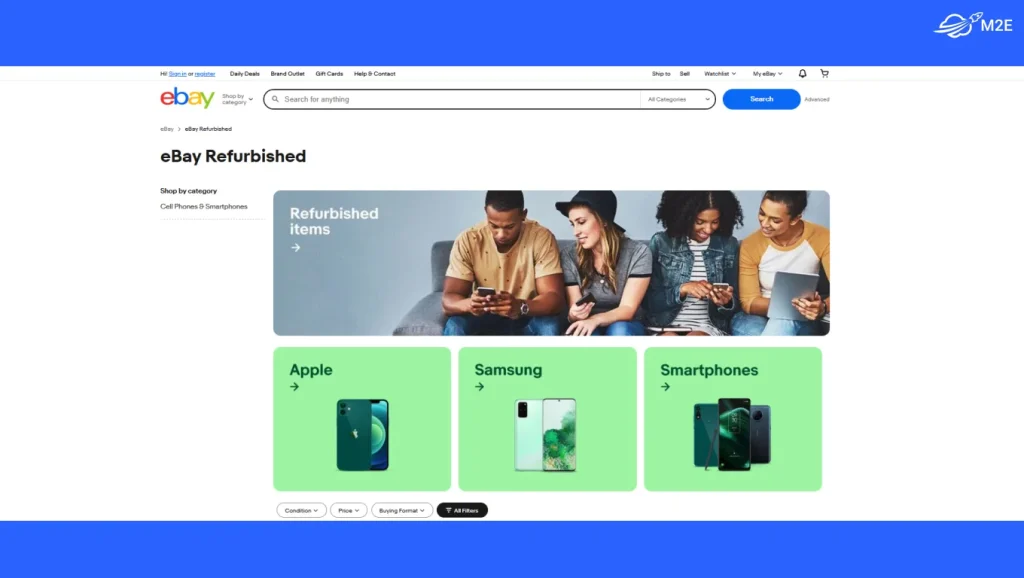
eBay works well for refurbished electronics because buyers rely on filters and clear condition ratings. If you consistently rate conditions and provide good service, you can build repeat volume without going through a closed-loop retailer-style program.
Registration is straightforward. You register a business account, add your company details, tax information, and bank account, go through standard verification, and you are ready to sell. But eBay Refurbished is not “automatic.” You need approval to use the Refurbished condition tiers, and your account has to stay in strong standing (service quality and low dispute friction are the real gate). If you are not approved for Refurbished tiers, eBay expects you to list the same items under regular Used conditions instead.
The program uses four levels: Certified Refurbished, Excellent, Very Good, and Good. Certified is the highest level. eBay defines it as being in mint condition, like new, and refurbished by the manufacturer or a manufacturer-approved supplier. The other levels are mostly cosmetic wear, ranging from minimal signs of use to moderate wear while remaining fully functional.
The real work on eBay Refurbished is staying consistent at the unit level. Your condition grade has to match the buyer’s experience every time. That means you need a repeatable check-and-test routine before shipping, so an item listed as Excellent always arrives looking and working like Excellent. This also helps keep returns under control and reduces “Item Not As Described” claims. eBay’s refurbished tiers reward sellers who can run reliable quality control, pack items safely, ship fast, and process returns without delays.
What You Pay on eBay Refurbished
- Three components. Store subscription add-on, listing fees (listing fees), and final value fees.
- Subscription. Starter plan – $4.95 per month.
- Final value fee. This includes the item price, shipping, and other amounts included in the commission base
- Commissions for refurbished electronics. Typically, around 13.6% of the total sale amount. 9.35% for certain categories of Computers/Tablets and Networking.
eBay Refurbished Eligibility and Performance Requirements
- Business seller account.
- Approval to use the eBay Refurbished condition tiers (Certified, Excellent, Very Good, Good). If you are not approved, you list the same items as Used instead.
- Top Rated Seller status and clean account standing, since eBay ties refurbished eligibility to seller quality.
- Strong service metrics, including at least 98% positive feedback, an Item Not As Described rate under 4%, and an Item Not Received rate under 1%.
- A baseline customer promise on refurbished listings: free shipping and at least a 30-day return window.
- Fast handling, because refurbished buyers still expect “new-like” service speed, and the program targets short handling times.
- Certified-only proof, if you want the top tier: documentation that shows refurbishment is manufacturer-authorized (for example, a purchase order or authorization letter).
- A repeatable inspection and testing workflow, so your chosen grade matches eBay’s definitions,s and you do not create preventable INAD returns.
Walmart (Walmart Restored)
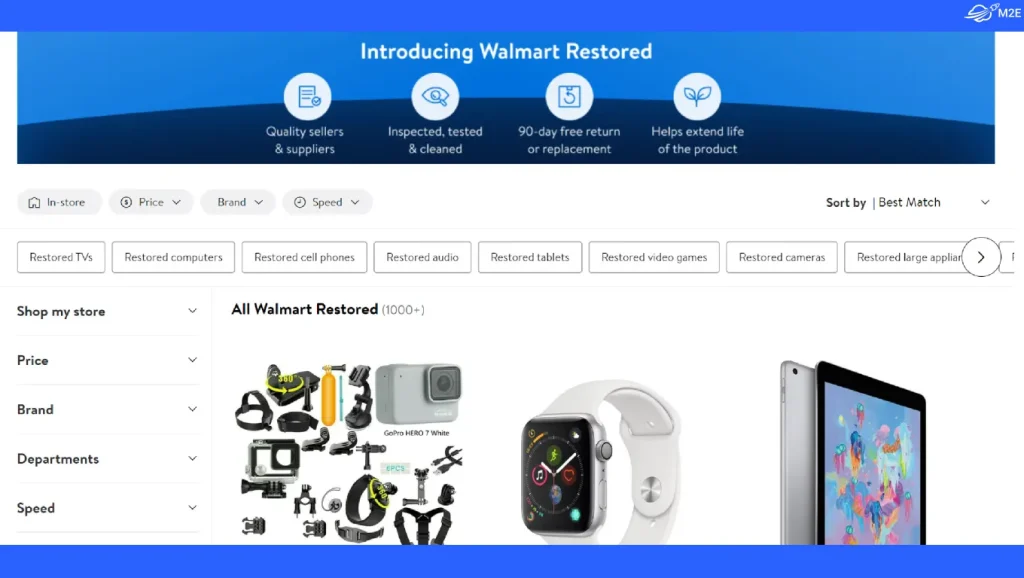
Walmart Restored is Walmart’s official way to sell refurbished items on Walmart.com with standardized, customer-focused condition labels. It sits within the broader “Restored at Walmart” experience, where shoppers can browse dedicated “Restored” sections (including a separate “Premium Refurbished” area) and shop by category, so that refurbished items aren’t mixed up in a random “used” corner.
Walmart Marketplace is an application-based ecosystem, and Restored is a controlled lane inside it. You use Walmart’s Restored condition types and match their definitions. If you use Restored tiers, Walmart also ties you to specific customer promise rules, including returns and, for some tiers, warranty expectations. You can deliver orders either with your own fulfillment (seller-fulfilled) or via Walmart Fulfillment Services, where eligible.
Walmart follows a simple and consistent condition model. For electronics and similar categories, refurbished items are listed as “Restored: Premium,” “Restored: Like New,” “Restored: Good,” or “Restored: Fair.” The differences are mostly cosmetic wear, but functionality is still expected in all aspects. Battery health is clearly defined: 80%+ for “Like New,” “Good,” and “Satisfactory” (where applicable), while “Refurbished: Premium” sets a higher bar of 90%+ and has additional requirements.
Customer protection is one of the reasons this channel converts. Walmart states that “Refurbished: Like New,” “Good,” and “Satisfactory” items come with a 90-day, free return guarantee, while “Refurbished: Premium” includes a minimum 1-year warranty (with some exceptions for specific products listed on the product page).
Items in any “Refurbished” condition must have been professionally inspected, tested, cleaned, and, if necessary, reconditioned. Walmart also lists operational requirements that you can include in your checklist: factory reset and unlocking where possible, firmware updates where possible, including accessories comparable to a new purchase, adhering to packaging guidelines, and deleting end-user data according to recognized media sanitization standards (Walmart cites NIST as an example).
Walmart Restored – Fees and Cost Structure
- Commissions for refurbished electronics
- Consumer Electronics: 8%
- Cameras & Camcorders: 8%
- Personal Computers: 6%
- If you use Walmart Fulfillment Services (WFS), add fulfillment + storage fees on top of the referral fee.
Requirements for Selling Refurbished Electronic Products on Walmart Restored
- You must use Walmart’s Restored condition options that are available for your product type, because these conditions are controlled by Walmart and are not seller-defined.
- Use Walmart’s Restored condition options exactly as defined (Restored: Like New, Good, Fair, Premium) and keep condition selection accurate at the unit level.
- A repeatable inspection, cleaning, testing, and refurbishment workflow that ensures every unit is fully functional and matches the Restored quality bar.
- Battery health compliance, where applicable: at least 80% for Restored Like New, Good, and Fair, and at least 90% for Restored: Premium.
- Returns and warranty obligations: support 90-day free returns for Restored Like New, Good, and Fair, and provide a minimum 1-year written warranty for Restored: Premium (with return rules based on Walmart’s Restored policy).
- Factory reset and secure data wipe to remove end-user data, using recognized media sanitization standards referenced by Walmart.
- Lithium battery compliance if you use WFS: follow Walmart’s battery compliance process (including WERCSmart where required) and provide battery test details when battery health is not visible in device settings.
TikTok Shop (Refurbished Electronics Category)
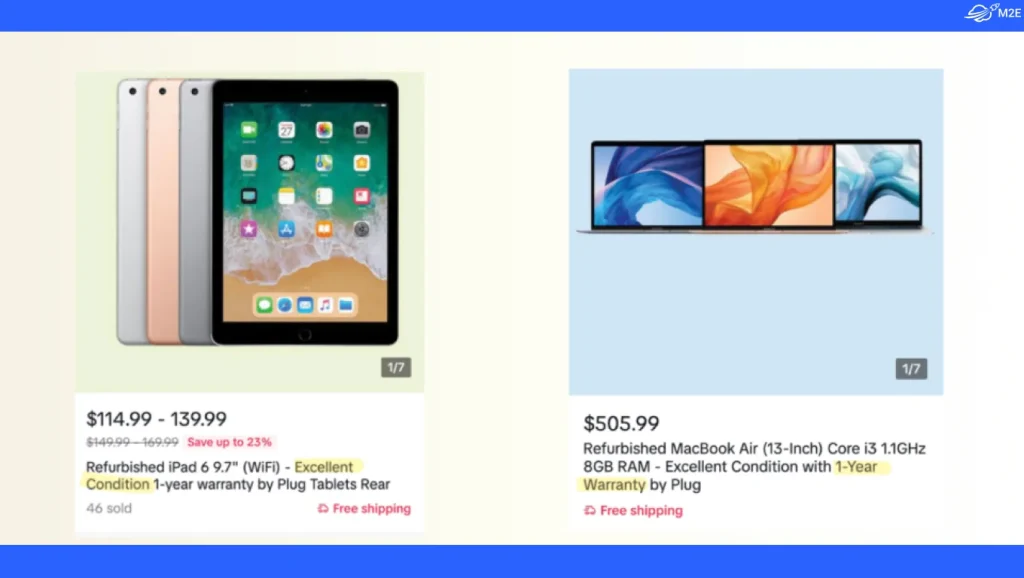
TikTok Shop may handle refurbished electronics, but primarily focus on finding new products. Marketplace lists refurbished devices in the “Refurbished Electronics” category and requires you to qualify for the category before you can list them.
To start selling on TikTok Shop, create a seller account in the TikTok Seller Center, submit required business documents (ID/tax info), and link your TikTok account. You need category approval, and TikTok expects documentation that proves supply and device-level verification. Their policy language is strict about what counts as refurbished, how you label it, and what proof you hold.
TikTok Shop offers multiple fulfillment paths, including seller shipping and platform-led options, depending on the market setup. The key point for a seller is that shipping and tracking performance is part of your account health, so you need a process that does not break when volume spikes.
Buyer trust here is built on documentation and proof. TikTok’s policy ties your listing claims to diagnostic results and evidence of data deletion. It also requires clear labeling: “Refurbished” must be clearly stated along with the brand and condition of the device. The device must have been released within the last 7 years. TikTok also sets measurable quality signals for refurbished devices with required diagnostic reports, including cosmetic checks and battery health thresholds.
TikTok Fee Structure for Refurbished Electronic Products
- Fees are category-based, so category mapping matters.
- TikTok’s fee table lists “Used + Refurbished Phones & Electronics” at:
- 5% per order
- 3% on the portion of the sale over $10,000
TikTok Shop Refurbished Category Approval and Documentation Requirements
- Category qualification approval for “Refurbished Electronic Products” through Seller Center (Qualification Center).
- Listing compliance: the listing must clearly state “Refurbished,” include brand and device condition, and meet TikTok’s eligibility rule for device release age.
- Purchase invoice: a legible manufacturer-issued invoice issued within the allowed window, with supplier details and a clear product description.
- Diagnostics + data wipe proof: diagnostic and data-erasure report(s) from TikTok-accepted providers (Phonecheck, Blancco, or Blackbelt), showing device identifiers and confirming data wipe.
- Quality thresholds must match proof: your condition and cosmetic claims, plus battery-health minimums, must be supported by the diagnostic report.
- Enforcement risk: missing or inconsistent documentation can trigger rejection, listing removal, and account health penalties.
Back Market (Refurbished Only Marketplace)
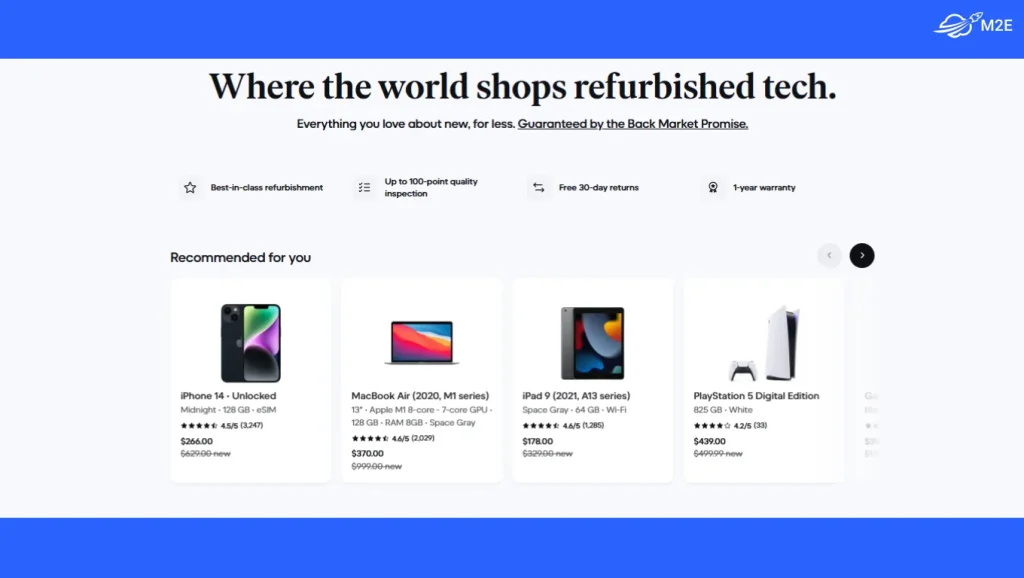
Back Market is one of the cleanest places to sell refurbished electronics, as the entire marketplace is built around refurbished electronics. Buyers come in expecting “refurbished” tech, not brand new retail.
Back Market is refurbished-first, but it is not frictionless. You are onboard as a professional seller and commit to platform rules that are built around quality and logistics reliability (delivery times, stock discipline, and product quality standards).
The primary mechanism is ratings. Back Market uses appearance ratings like “Fair,” “Good,” “Excellent,” and “Premium,” while promising that the device is 100% functional regardless of the rating. For smartphones, Back Market also clearly defines practical differences: “Premium” is geared toward “like new” with original parts and sets expectations for battery life (“Premium” is often associated with higher battery life, while “Excellent” typically expects at least 80% battery life).
In the U.S., Back Market gives buyers 30 days to return an item, and items are covered by a 1-year seller-provided limited warranty that starts from the date of delivery. Back Market’s warranty policy also defines this as the seller’s responsibility: the seller guarantees that there are no defects for 12 months, and has set out the timeframes for processing returns and offers for repairs, exchanges or refunds.
From an operational perspective, Back Market forces you to be consistent. You need clear quality control, predictable pricing, and clear handling of returns and warranty cases. Back Market’s marketplace disclosures also highlight that product visibility is influenced by a ranking approach that takes into account price and quality metrics (e.g., defect rate and delivery delay rate), and the platform may display one “best” offer for each product and variety.
By region, Back Market is available in 13 European countries, as well as the UK, the US, Australia, and Japan. In the US, shipping is currently limited to the 48 contiguous states. Plan your inventory and warranty operations by region.
Back Market Pricing
- Pricing is typically contract-level
- Public disclosures describe the seller cost as:
- a monthly flat fee
- a commission on confirmed transactions
Practical takeaway: confirm your exact rate in the contract, then model margin per category and return rate.
Requirements for Selling Refurbished Electronic Products on Back Market
- Your business must adhere to the General Seller Terms and Conditions and the Back Market Quality Charter, including the platform’s quality criteria for logistics management (delivery times, inventory management, and quality of delivered products).
- Accurately rate devices (Premium/Excellent/Good/Satisfactory) and ensure the same rating across the entire catalog.
- Ensure full functionality of devices regardless of cosmetic grade.
- You must provide Back Market’s 1-year limited warranty, offered by the seller and valid for 12 months from the date of delivery.
- You must support the right to return within 30 days, as Back Market’s return policy states that buyers have 30 days after receiving their order to return it to the seller.
- When you list phones as premium, Back Market states that this grade implies impeccable interior and exterior condition, as well as restoration using “original parts,” so your sourcing and restoration process must be consistent with this statement.
Manage Refurbished Electronic Products Sales Across Marketplaces with M2E Cloud
Refurbished electronics is unit-based selling. You are moving individual devices with their own condition grade, test result, and return risk. Even in one marketplace, small gaps in product data or condition matching can quickly turn into returns, “not as described” claims, and account health issues.
Once you expand to multiple marketplaces, the pressure goes up. Each platform has its own refurbished program rules, condition tiers, and customer promises. That means you are not just listing more. You are keeping the same unit consistent across different rulebooks. Inventory must stay accurate, listings must stay compliant, and order updates must stay in sync, so the same device is not sold twice.
M2E Multichannel Connect helps by putting listings, inventory updates, and orders into one workflow. You manage refurbished sales with cleaner data, fewer manual steps, and more predictable operations, whether you sell on one channel or across several.
Here’s what it looks like in day-to-day operations:
- Cleaner listings with fewer failures. Each marketplace enforces its own required fields, category rules, and product data formats. M2E supports structured listing workflows and helps you prepare data the way the channel expects. The Listing Validator Assistant checks listings before submission and shows what needs fixing, so you catch issues early instead of debugging failed uploads later.
- Unit-safe inventory control. Refurbished inventory is limited and unit-sensitive. One wrong quantity update can cause overselling, cancellations, and account damage. M2E keeps inventory aligned between your store and connected marketplaces, so quantity changes sync automatically and the risk of double-selling the same unit drops.
- One order workflow with tracking sync. Orders come into one queue instead of being split across multiple dashboards. When you ship, tracking and order status updates can sync back to the marketplace without copy-paste. That saves time and reduces delivery mistakes.
- Performance monitoring. If you want consolidated reporting, you can connect to M2E Analytics and monitor key signals in one place, like cancellations, stockouts, listing failures, and late shipments. That helps you spot operational issues before they become account problems.
- A single system as you scale. If you sell on Amazon, eBay, Walmart, and TikTok Shop, M2E lets you run them from one account. You reuse mappings and workflows instead of rebuilding the process for every marketplace. It is the difference between being able to list and being able to scale.
This matters more for refurbished than for new goods because consistency is part of the product. Clean condition data, stable identifiers, and accurate stock handling reduce manual edits, reduce errors, and make growth feel like higher volume, not higher chaos.

Conclusion
Fees and rules differ a lot across refurbished programs, so the best marketplace is the one that fits your margin and your workflow.
Walmart Restored is often the lowest fee option for electronics, but it comes with strict condition, battery, and returns requirements. Amazon Renewed is typically more expensive because you pay the standard referral fee plus an extra Renewed fee, and mistakes are punished faster, but the trust layer can improve conversion. eBay Refurbished often sits in the middle on fees and entry friction, but your results depend on accurate grading and service quality. Back Market is contract-based with a monthly fee plus commission, and you are paying for a refurbished first audience. TikTok Shop can be low fee, but it may require supplier invoices, diagnostic reports, and proof of data wipe for refurbished listings, which increases operational workload.
Whichever channel you choose, M2E Multichannel Connect helps you run refurbished sales with less manual work by keeping listings, inventory, and orders under control in one workflow, and it becomes even more valuable once you expand to multiple marketplaces.


