


Salesforce Commerce Cloud (SFCC) is one of the most advanced e-commerce platforms for brands that want to scale across both B2C and B2B markets. It stands out for its deep connection to the Salesforce ecosystem, giving merchants a single view of customers, powerful AI personalization, and enterprise-level scalability.
Think of SFCC as the brain of your business. Customer data, storefronts, and operations all run through it. But if you want to grow and launch a store on Amazon, eBay, Walmart, TikTok Shop, Kaufland, or Temu, the goal isn’t to manage them as separate silos – it’s to keep them connected to this central hub.
The challenge is that Salesforce Commerce Cloud doesn’t provide native integrations for these marketplaces. While you can certainly sell on them, keeping product data, inventory, and orders in sync with Salesforce requires additional effort.
This is where M2E Multichannel Connect comes in. The solution bridges Salesforce Commerce Cloud with the world’s leading marketplaces, giving sellers a fast and reliable way to synchronize products, orders, and inventory across every channel.
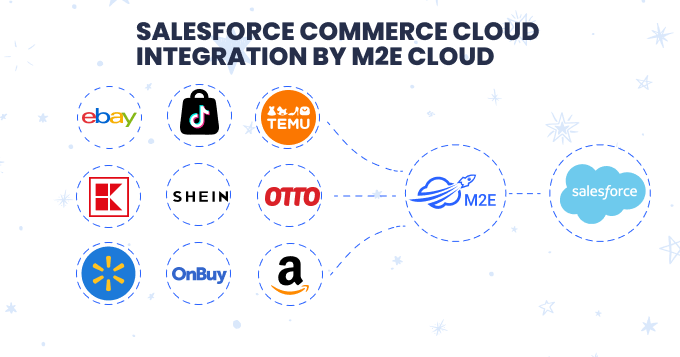
In this article, we will look at the strengths of Salesforce Commerce Cloud inside the Salesforce ecosystem, the challenges of marketplace integration, and how M2E Multichannel Connect solves them.
What Is Salesforce Commerce Cloud?
Salesforce Commerce Cloud (SFCC) is a cloud-based e-commerce platform that allows businesses to create and manage online stores, process orders, handle product catalogs and pricing, and deliver personalized shopping experiences. It supports multiple sales channels, from websites and mobile apps to social media and even offline retail locations.
What makes SFCC stand out is its deep connection to the Salesforce ecosystem. Data from commerce, marketing, and customer service is brought together in one place, giving brands a complete view of their customers and the tools to scale effectively.
The platform supports both B2C and B2B business models. Retailers can sell directly to consumers, while wholesalers can manage bulk orders and custom pricing from the same system. This flexibility makes it a strong choice for companies that want to grow without switching between multiple platforms.

Another strength is its enterprise-level scalability. SFCC was designed for global brands that need multi-currency support, multilingual storefronts, and complex tax or pricing rules. Combined with built-in tools like Einstein AI for personalization and forecasting, it gives sellers the ability to deliver tailored shopping experiences across every channel.
In short, Salesforce Commerce Cloud is more than an online store. It is a commerce hub that ties customer data, operations, and marketing together, creating a foundation for seamless growth.
Key Benefits of Salesforce Commerce Cloud within the Salesforce Ecosystem
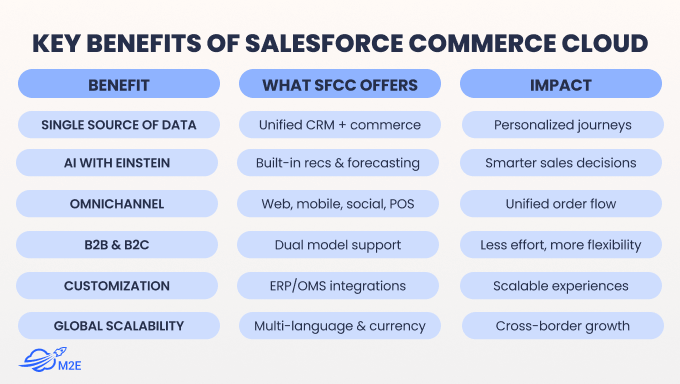
Salesforce Commerce Cloud shows its actual value when used as part of the wider Salesforce ecosystem. The platform is more than a sales channel – it ties commerce to CRM, marketing, and service in one place.
Below are the key benefits that make SFCC stand out for growing brands.
Benefit #1. Single source of customer data
Salesforce Commerce Cloud connects directly with Salesforce CRM, making it more than just a storefront. Every customer detail lives in one ecosystem – from contact information and purchase history to support cases and marketing campaigns. This unified view is a game-changer for personalization.
Instead of juggling multiple tools, sellers can pull insights from one database and act on them instantly. The result is smoother customer journeys and better loyalty.
Benefit #2. AI personalization with Einstein
Einstein AI is one of SFCC’s strongest built-in features. It delivers product recommendations tailored to browsing behavior, adjusts pricing dynamically based on demand, and forecasts inventory needs with predictive analytics.
What makes this stand out is that Einstein comes included. Competing platforms like Shopify often require separate paid apps to offer similar AI-driven tools. For Salesforce users, personalization is available from day one, with no extra integrations or hidden fees.
Benefit #3. Omnichannel comes out of the box
Modern customers don’t stick to one shopping channel, and Salesforce Commerce Cloud addresses this reality head-on.
With SFCC, brands can manage websites, mobile apps, social commerce storefronts, and even point-of-sale in physical shops from one platform.
Every order funnels into Salesforce, creating a unified order flow. This reduces errors, improves stock visibility, and lets teams respond faster to shifts in demand across channels.
Benefit #4. B2B and B2C sales in one platform
Many e-commerce platforms force businesses to separate B2B and B2C operations. Salesforce Commerce Cloud allows both models to run side by side on the same system.
A company can serve retail shoppers and wholesale buyers without duplicating catalogs or websites. This flexibility saves time and reduces overhead, while still supporting advanced pricing tiers, account-based selling, and negotiated contracts for B2B.
Benefit #5. Deep customization and headless architecture
Salesforce Commerce Cloud is built with enterprise flexibility in mind. Its headless architecture allows developers to design unique storefronts and deliver consistent experiences across web, mobile, apps, or even IoT.
Brands can integrate SFCC with ERP, OMS, and third-party systems without hitting the technical limits that often come with mid-market platforms. For companies that need a custom customer journey or advanced back-end integrations, SFCC provides the freedom to scale without compromise.
Benefit #6. Scalability for global brands
Global retailers face challenges that go beyond language translation. They need multi-currency pricing, localized promotions, and compliance with regional tax laws.
SFCC covers these needs out of the box. The platform supports complex pricing rules, global catalogs, and local fulfillment models. For businesses that operate in multiple regions, this scalability reduces the need for heavy customization and keeps operations consistent worldwide.
Salesforce Commerce Cloud Pricing Explained
Salesforce Commerce Cloud follows a usage-based model where fees are tied to Gross Merchandise Value (GMV). According to the official Salesforce Pricing page, costs scale with sales volume.
Independent reviews, like Twelverays’ breakdown, note that the Starter plan begins at 1% of GMV and the Growth plan at 2% of GMV annually.
This model aligns with business growth but can feel steep for high-volume sellers. On the other hand, it allows smaller merchants to enter the Salesforce ecosystem at a lower upfront cost while larger enterprises pay in proportion to the value they generate.
Why Marketplace Integration Is Important
Salesforce Commerce Cloud is robust in the Salesforce ecosystem. It brings together marketing, service, and commerce in one place. On the other hand, SFCC doesn’t have native connections with Amazon, eBay, Walmart, TikTok Shop, Kaufland, or Temu.
For most companies, this is a major choke point. Marketplaces fuel growing segments of cross-border online sales:
- Amazon accounts for about 40% of U.S. e-commerce
- TikTok Shop and Temu are rapidly gaining popularity in Europe and the U.S.
Without access to marketplaces, sellers risk being excluded from the shopping channels where customers already spend their money.
There are no ideal substitutes. Sellers try to craft custom API integrations between SFCC and each marketplace. This is costly, time-consuming, and difficult to maintain as marketplaces update their APIs. Others resort to manual uploads and spreadsheets, which are not scalable for businesses handling hundreds or thousands of SKUs.
The result is siloed data. Inventory data is lagging by channel, prices vary, and orders are transacted in separate systems. These disconnects can potentially lead to overselling, order discrepancies, and poor customer experiences – the very ones Salesforce Commerce Cloud is designed to prevent.
This is where a bridge like M2E Multichannel Connect steps in. It connects Salesforce Commerce Cloud to leading marketplaces, allowing sellers to synchronize product catalogs, stock levels, and orders almost in real time. Instead of managing each channel individually, merchants can leverage the full power of Salesforce across the world’s largest marketplaces.
Marketplace selling without vs. with M2E Multichannel Connect
| Without Integration (native SFCC only) | With M2E Multichannel Connect | |
| Marketplace access | No native links to Amazon, eBay, Walmart, TikTok Shop, Kaufland, Temu | Direct sync with leading marketplaces |
| Data management | Manual uploads, spreadsheets, custom APIs | Centralized updates in Salesforce |
| Inventory & pricing | Lagging stock data, inconsistent pricing | Regular sync across all channels |
| Orders | Split across separate systems | Unified inside Salesforce |
| Scalability | Costly to maintain, not scalable for large catalogs | Scales with thousands of SKUs |
| Customer experience | Risk of overselling and order errors | Smooth, consistent experience |

How M2E Multichannel Connect Works with Salesforce Commerce Cloud
Linking SFCC to leading global channels lets merchants expand their reach without adding technical complexity. Here’s how M2E Multichannel Connect works in practice.
Easy setup in a few steps
Onboarding M2E Multichannel Connect is fast. Most merchants can complete the initial setup in 10–15 minutes. It’s simple:
- Connect your Salesforce B2C account. Authorize the integration through API credentials.
- Add marketplace accounts. Link Amazon, eBay, Walmart, TikTok Shop, or other supported channels.
- Link products. Map Salesforce SKUs to marketplace listings, either manually or automatically. Bulk linking through CSV files is also available.
- Enable synchronization. Turn on real-time or near real-time sync for prices, inventory levels, and product details.
- Set order preferences. Choose how marketplace orders are imported into Salesforce and processed through the standard workflow.
- Publish listings. Push items directly to marketplaces from Salesforce, with control over pricing, categories, and listing templates.
Each of the steps above is designed to work within the Salesforce interface, so that sellers don’t have to switch between different dashboards.

Advanced features for growing sellers
On top of standard listing and syncing, M2E Multichannel Connect includes advanced features that make multichannel commerce easy to scale:
- Regular syncing ensures product details, inventory, and order statuses are always up to date.
- Bulk linking and CSV import/export streamline catalog management for large product ranges.
- Centralized order management consolidates all marketplace orders in Salesforce for combined processing.
- Amazon Repricer and Sales Analytics allow sellers to stay competitive with dynamic pricing and performance insights.
- Omnichannel Inventory (OCI) allows brands to manage stock across multiple locations and prevent overselling.

With these features, M2E Multichannel Connect transforms Salesforce Commerce Cloud into a true multichannel hub. Merchants benefit from marketplace exposure without losing the control and visibility of Salesforce.
The Bottom Line
Salesforce Commerce Cloud is known for its scalability, flexibility, and deep customization options. It brings every element of the Salesforce ecosystem – from CRM to marketing and service – into a single source of truth for enterprise sellers.
In the Salesforce extension marketplace, you’ll always find the integrations you need. And if your goal is to connect multiple marketplace accounts and stores into one Salesforce core, M2E Multichannel Connect makes it simple.
With rapid setup, live sync, bulk linking, and advanced tools like repricing and analytics, M2E turns Salesforce Commerce Cloud into a true multichannel hub.
If you’re ready to expand your Salesforce store to new sales channels, now is the time to try M2E Multichannel Connect. And if TikTok is part of your growth strategy, explore the dedicated solution for the Salesforce TikTok Shop Cartridge to start selling where your customers already spend their time.


