

TikTok Shop is quietly reshaping e-commerce in LatAm. In some countries, it already works as a full marketplace inside the app. In others, it is still a mix of early tests, affiliate links, and creator experiments.
Below is a country-by-country view of the current rollout, how mature each market is, and how sellers can plug TikTok into their existing sales stack instead of waiting for a “perfect” launch.
Countries With TikTok Shop Access Today
1. Mexico
TikTok Shop launched in Mexico in 2023. Mexico was one of the first Latin American countries to get the full TikTok Shop feature set, so it became a testing ground for affiliate programs, product tags, live shopping, and in-app payments.
Research shows that Mexico could become the 5th fastest-growing e-commerce market. Major retailers like Amazon, Walmart, and Mercado Libre are investing billions into their Mexican operations to capture this early-stage customer base. As Benator puts it, “Mexico and Latin America are some of the fastest growing e-commerce markets in the world.”
TikTok Shop user behavior fits this picture. Since 2023, seller registrations on TikTok Shop in Mexico have grown by about 300%. Users spend more than 70 minutes per day on the platform on average. Fashion, skincare, and mobile accessories are the strongest categories.You can follow the setup process in the M2E Cloud TikTok Shop Mexico seller registration guide.
2. Brazil
TikTok Shop is available to local sellers in Brazil. The service officially launched in May 2025, making Brazil TikTok’s second Latin American market after Mexico.
Growth after launch has been fast. Within the first three months, monthly GMV went from about US$1 million to US$25.7 million. In August 2025, TikTok Shop Brazil reached US$46.1 million in GMV, a month-on-month increase of 79.4%, bringing it close to the US$50 million mark.
Brazil is a strategic market for TikTok. The country ranks third globally in the number of TikTok users. The app leads the 2025 download rankings in Brazil ahead of Temu and Mercado Libre. For now, TikTok Shop in Brazil operates as a marketplace where sellers handle their own shipping and customs. Around half of GMV comes from the shop tab, with short videos and live streams generating the rest.
For a step-by-step setup, see the official M2E Cloud TikTok Shop Brazil seller registration guide.
3. Colombia
Colombia entered the TikTok Shop rollout quietly, through limited beta launches rather than a big public release. The new tools are being tested by a select group of sellers who already have an existing e-commerce infrastructure and joined the early seller program.
TikTok usage in Colombia is up 45% compared to the previous year, and that growth is shaping early commerce behavior. This is where short videos win. Even though the market is still developing, it produces better results than direct commerce. Electronics and skincare are among the strongest categories, and influencer-led affiliate campaigns are on the rise.
Colombia is already confirmed as one of the TikTok shopping countries for 2025, so these early tests are directly linked to the upcoming expansion of TikTok Shop in the market.
4. Chile
Chile is still in the testing phase of TikTok Shop. A limited group of creators have been given access to basic features. These include affiliate links and product tagging. However, full native checkout is still not available.
However, Chile has no less potential than Brazil. The country ranks third in Latin America in terms of digital commerce adoption. This is a good indicator that makes it the next candidate for TikTok Shop expansion in the region. After all, existing logistics and payment partnerships indicate that full functionality of TikTok Shop in Chile could happen after the testing is completed.
5. Peru
Currently, the TikTok Shop is not fully available in Peru. It does not have official features. However, economically and socially, this country can very easily adapt to how TikTok works as a channel.
Creators in Peru often add manual links to external shops instead of using native shopping tools. At the same time, e-commerce in the country is growing at around 18% per year, and mobile penetration is high, which makes Peru a market that is well-suited for a future TikTok Shop rollout.
How to Work with TikTok Shop in LatAm
How you work with TikTok Shop in Latin America depends on how much functionality your market already has.
Countries With Full TikTok Shop Access (For Example, Mexico)
- Register as a merchant in TikTok Shop Manager
- Add payout details and connect local delivery providers
- Use product tags in short videos and live streams so customers can place and complete orders inside TikTok
Countries Where TikTok Shop is Still Limited or Unavailable
- Treat TikTok as a traffic and demand source and send users to Shopify, Mercado Libre, or your own store using links or available affiliate tools
- Partner with creators who already test early shopping features
- Monitor TikTok Seller Center and local updates to react quickly when your country gets a wider rollout
In both cases, the point is to build reach and trust on TikTok before broader launches make competition for users and creators much tougher. TikTok activity should fit into your overall Latin America market entry plan, not live as a separate side experiment.
TikTok Shop in Latin America: Rollout by Country
TikTok Shop does not look the same across Latin America. The table below shows where key markets stand in 2025, what access level they have, and which commerce features are already live.
| Country | Access level | What is available today |
| Mexico | Full launch | Manual links to outside stores, creator-driven sales on the rise |
| Brazil | Full launch | TikTok Shop is available for local Brazilian sellers |
| Colombia | Pilot phase | Campaigns run only with a limited group of creators and merchants |
| Chile | Early testing | Product tagging and affiliate tools, shopping still happens off platform |
| Peru | External checkout only | Product tagging and affiliate tools, shopping still happens off-platform |
High-Potential Markets for the Next TikTok Shop Wave
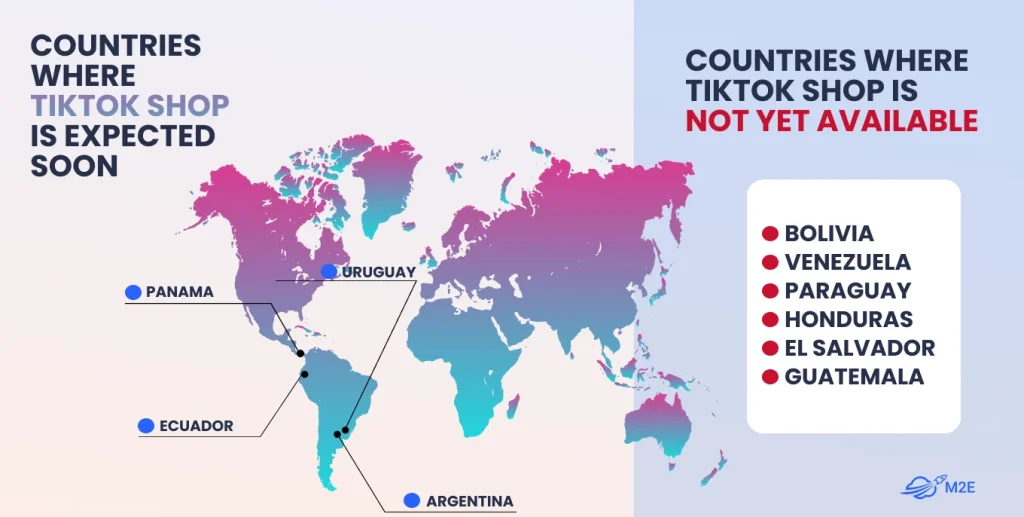
Several Latin American countries do not have a full TikTok Shop yet, but already show the right signals for future expansion. Here is what stands out in each of them.
- Argentina is known for high engagement and a strong creator culture. Many creators already focus on product tutorials and recommendation-style content, which aligns well with TikTok commerce formats.
- Ecuador has a growing online retail scene, and cross-border commerce is gaining speed. This creates a natural base for adding social commerce layers on top of existing eCommerce activity.
- Uruguay has a small but tech-forward population. That makes it suitable for early experimentation and controlled pilot programs before wider rollouts.
- Panama stands out for its high concentration of influencers and developed fintech infrastructure. This combination supports creator-driven campaigns and the payment flows needed for TikTok Shop to run smoothly.
What Drives TikTok Shop Rollout Decisions
Rollout across Latin America is not uniform. Some countries get full access much earlier. The picture is changing fast from country to country. The pattern usually comes down to three things:
- Digital payments
The platform needs users who can pay inside the app in a few simple steps. Where digital wallets and online card payments are common, it is much easier to switch on in-app checkout and keep the buying flow inside TikTok Shop.
- Fulfillment capacity
It is not enough to let people pay. Orders have to move through warehouses and delivery networks without major delays. Countries that have stable fulfillment and storage options can support regular online orders, returns, and higher volume once TikTok Shop is live.
- Ecosystem readiness
TikTok Shop depends on creators and local partners who know how to sell through content. Training programs, local support, and partner initiatives help creators use product tags, live sessions, and affiliate tools in a structured way.
When these elements align, TikTok can deploy the full TikTok Shop feature set with lower risk.
TikTok Shopping across LatAm: Why It’s Not Optional Anymore
TikTok-driven commerce in Latin America is already changing how people buy online instead of just generating hype around a trend.
- Social commerce revenues in Latin America are projected to reach around 20 billion USD by 2025.
- The country has a smartphone usage rate of over 80%, and over 60% follow influencers who recommend or sell products.
This is the case where all the pieces fit together perfectly. Entertainment, influence, creator trust, creativity, impulse buying, desire, growth potential all come together in one place. TikTok doesn’t replace classic product search or display advertising, but it works great in tandem.
Managing TikTok Shop and Marketplaces With M2E
You can use M2E to list your products on TikTok Shop in Latin America. Our TikTok Shop guides and documentation walk you through connection, product mapping, and sync settings in a step-by-step manner. If you have questions at any point, you can reach out to support and get help finishing the setup.
M2E Multichannel Connect keeps your product data in one place, updates inventory in real-time, and syncs orders and shipment statuses across all channels. You can change prices and quantities in bulk, set separate rules per marketplace, and manage all listings from a single interface instead of switching between multiple dashboards. After TikTok Shop is connected, you can use the same tool as a control center for other marketplaces such as Amazon, eBay, Walmart, Temu, Kaufland, and more.

What Comes Next
TikTok Shop in Latin America is scaling fast. Mexico already behaves like a mature model. Brazil and Argentina are positioned to follow with large user bases and creator ecosystems. Colombia, Chile, and Peru are building volume through pilots and indirect flows. The key question is shifting from “Which countries have TikTok Shop now?” to “Which Latin American markets will set the new standard for social commerce?”
Chances are, most likely those answers will come from this region.

