


Choosing the right eCommerce platform is key to scaling up. BigCommerce Enterprise flexes with B2B prowess and flexibility, while Shopify Plus dazzles with its integration magic and automation flair. In this quick showdown, we’ll compare these two heavyweights across 9 key areas—from SEO to wholesale—so you can find your perfect match. Let’s dive in!
BigCommerce Enterprise: Brief Overview
BigCommerce Enterprise is a premium extension of the BigCommerce platform, designed for retailers needing more robust capabilities. Unlike the standard BigCommerce, which caters to small and medium businesses (SMBs) with affordable resources, BigCommerce Enterprise offers advanced features to handle high traffic and complex operations, making it ideal for larger enterprises.
If your business demands a more robust, scalable solution, BigCommerce Enterprise could be the next step.
Key Highlights:
- Cost-Effective Powerhouse: BigCommerce Enterprise offers rich features and resources at a competitive cost, providing excellent value without breaking the bank.
- Trusted by Major Brands: With a growing list of B2B and B2C clients, including big names, BigCommerce Enterprise proves its reliability and market fit.
- Rapid Growth: Expanding into Europe and attracting top brands, BigCommerce Enterprise is a fast-growing platform that ensures it stays ahead in the dynamic eCommerce landscape.
Shopify Plus: Brief Overview
Shopify Plus is a top-tier extension of the original Shopify platform, renowned for its strong global presence and appeal to fashion and lifestyle brands. The regular Shopify is perfect for the small business crowd, and Shopify Plus is the VIP pass for big players in B2C, offering top-notch infrastructure and a global stage.
Why Shopify Plus Rocks:
- Money Well Spent: Shopify Plus packs a punch with a wealth of resources and features, making it a steal for fashionistas and creatives who want to shine.
- Integration Maestro: Shopify Plus is a whiz at connecting with other apps and services, making scaling your business smoother than a catwalk strut.
- Tried and True: With a client roster that reads like a who’s who and a history that speaks volumes, Shopify’s track record is as solid as they come.
9 Key Differences: BigCommerce Enterprise vs Shopify Plus
Want to boost your online sales? BigCommerce delivers unbeatable SEO and catalog control for complex needs, while Shopify Plus shines with seamless automation and integrations for rapid scaling. Let’s explore other opportunities. And remember, no matter which eCommerce platform you choose, M2E Cloud supports both data sources. About how to install and use it, you can read our documentation.
Pricing Comparison

BigCommerce Enterprise starts at $1,000/month, with fees scaling up to $15,000 based on sales, plus a 2.9% + $0.30 credit card fee.
Shopify Plus begins at $2,300/month (for a 3-year plan) and a lower 2.15% + $0.30 credit card fee.
SEO Agility

SEO is crucial for driving online sales, and while both BigCommerce and Shopify Plus offer solid SEO tools, BigCommerce stands out for its greater flexibility. Thus, Shopify automatically adds certain prefixes to the URLs of products and collections. In addition, BigCommerce allows more control over critical elements category hierarchy.
For instance, BigCommerce lets you tweak the URL structure and set up parent-child category relationships—features that can seriously boost your SEO game. While small businesses might not dive into these deep customizations, they can be a game-changer for savvy owners and larger enterprises craving more control over their digital footprint.
Maria Harutyunyan, CEO of Loopex Digital suggests that businesses looking for long-term SEO success should prioritize platforms that offer this level of customization:
“Customizable URL structures and category setups allow businesses to enhance keyword relevance, making it easier for search engines to crawl and index their sites efficiently. This way businesses can position themselves for better organic search performance and sustainable growth.” Maria Harutyunyan, CEO of Loopex Digital
Product Lifecycle Management

A well-organized product catalog is crucial for guiding customers to what they need. Regular updates and clear listings—great images, concise descriptions—are essential across all platforms.
Shopify Plus delivers straightforward product lines and a user-friendly interface, perfect for small to medium-sized businesses looking for ease and efficiency. Still, Shopify Plus doesn’t have built-in features for managing the entire product lifecycle. Companies often rely on third-party apps or integrations, like ERP systems, PIM (Product Information Management) platforms, or custom solutions to handle this. Ths Shopify does offer basic product lifecycle management features, but for highly complex management needs, it might not be the best fit. In addition, Shopify Plus has no specific limits on the number of SKUs. You can add as many products and variants as you need, making it an ideal platform for large businesses with extensive catalogs.
BigCommerce Enterprise excels with advanced catalog management, offering more flexibility and scalability for more extensive, intricate catalogs. It allows detailed organization and customization, making it easier for customers to find exactly what they need, ultimately driving higher sales. However, you can connect third-party apps to further enhance the structure, allowing for more advanced product lifecycle management.


With the M2E Cloud Multichannel solution, you can effortlessly sync your products across eBay, Amazon, Walmart, and various data sources. Thus, you can create listings on multiple marketplaces and easily make bulk updates. The app keeps your stock updated in real time, ensuring you never oversell. For example, if you want to learn to import Amazon products to BigCommerce or Shopify via M2E Cloud, remember to check our blogs. If you are a store on BigCommerce and selling with eBay, read these tips to maximize your sales.
User Experience

Shopify and BigCommerce are designed with intuitive, user-friendly interfaces that make managing your e-commerce site straightforward. However, Shopify has a slight edge in ease of use, offering a slightly more streamlined experience (Still, this isn’t the author’s take—it’s a collection of user reviews gathered from public sources).
Both platforms allow you to easily edit content, features, apps, and automation, though the complexity can increase with the size of your business or the extent of changes needed.
If you ever face challenges, Shopify Plus and BigCommerce Enterprise offer 24/7 customer support to guide you through everything from dashboard management to more complex coding and customization tasks.
Ability to Scale

A solid marketing platform needs to be extensible and show continuous growth. Shopify and BigCommerce excel in these areas, demonstrating a commitment to innovation and adaptability.
Thus Shopify Plus lets you scale with ease, thanks to Shopify Flow’s automation and Shopify Scripts’ personalized shopping magic. Also, Shopify Plus is stepping up in marketing, automation, and more. With powerful marketing tools and apps like CRM integration and advanced analytics, it’s ready to scale your business—whatever your goals may be.
BigCommerce has made significant strides, particularly with its focus on headless architecture, expanding integrations, and entering the international market. This progress signals that BigCommerce is staying ahead in the ever-evolving eCommerce landscape.
While both platforms support extensions like Enterprise Solution, BigCommerce leans more towards complexity. It offers greater flexibility for adding and managing extensions, making it a strong choice for businesses needing advanced customization.
Meanwhile, with the M2E Multichannel Connect, you can expand your reach across top marketplaces like eBay, Amazon, Walmart, Shopify, and BigCommerce with just a few clicks—no special skills needed. The app keeps your inventory in sync 24/7, automating manual updates and effortlessly ensuring everything stays current, so you can save time and avoid the hassle.
Effective Integrations

Shopify Plus and BigCommerce offer strong integrations with systems like AMS, POS, and OMS, which are essential for smooth online operations. As we said before, Shopify Plus stands out with a bigger integration network and many systems partner exclusively with its agencies.
BigCommerce is closing the gap, boasting a faster API with 400 calls per minute compared to Shopify’s 10. This means that Shopify Plus could drag on what takes minutes on BigCommerce. Thus while Shopify shines in variety, BigCommerce scores on speed and efficiency.
Remember that M2E Cloud enables swift integration with leading CRM systems. With API connectivity, users can effortlessly sync data and fully harness integrated customer insights across platforms. Meanwhile, check out our blog about the best eBay, and Amazon Shopify integrations.
Process Automation
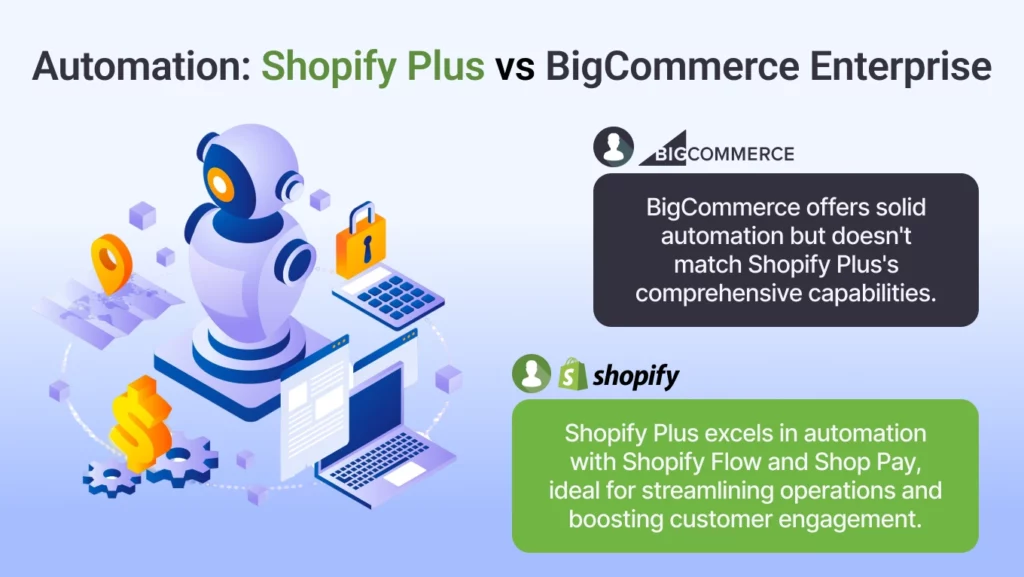
Automation is essential for streamlining tasks, and Shopify Plus takes the lead with Shopify Flow. It automates notifications, tagging, fraud and order management, and more, all while integrating seamlessly with other apps.
Shop Pay, Shopify’s one-click checkout, boosts conversions by simplifying purchases. Plus, automated tools for surveys and reviews keep your customers engaged effortlessly. BigCommerce also offers automation, but Shopify Plus makes your business smoother.
No worries—the M2E Multichannel Connect app automatically syncs orders and shipment statuses with every purchase, so you can manage everything from one seamless interface.
Sales Promotions

Shopify Plus and BigCommerce offer robust tools for promotions and discounts, which are essential for boosting sales. Shopify Plus shines with Shopify Scripts, allowing sellers to create customizable discounts. However, it’s limited to one script per category at a time. Let’s take a quick look at how it works.
Shopify Scripts is a Shopify Plus feature that lets you customize the checkout experience to boost sales. With Scripts, you can manage discounts, payment options, and shipping rates without hassle.
Key Shopify Scripts features include:
- Bundle Discounts: Offer discounts for specific item bundles.
- BOGO (Buy One, Get One Free): Clear out stock with popular BOGO deals.
- Free Shipping: Lower cart abandonment by offering shipping discounts.
- Tiered Discounts: Encourage bigger orders with savings that grow as customers add more items.
- Free Gift with Purchase: Reward customers with a free item when they hit a spending threshold.
Scripts allow you to create a tailored shopping experience that drives conversions and meets complex business needs.
Finally, Shopify’s one-click checkout streamlines the purchase process, driving higher conversions, while automated survey and review tools keep customer engagement effortless. With Shopify Flow, businesses can automate notifications, tagging, fraud detection, and order management for a smoother operation.
BigCommerce doesn’t use a script system but supports over 70 different types of discounts and promotions, offering plenty of flexibility for sellers looking to attract customers with special offers. In addition, BigCommerce Enterprise allows the use of custom workflows via API. Thus you can create and manage tailored promotional strategies. Also, you can automate complex discount rules, personalized offers, and targeted campaigns, ensuring your promotions are precisely aligned with your business goals and customer segments. This level of customization helps you deliver unique and effective promotional experiences, driving customer engagement and sales.
Wholesale Distribution
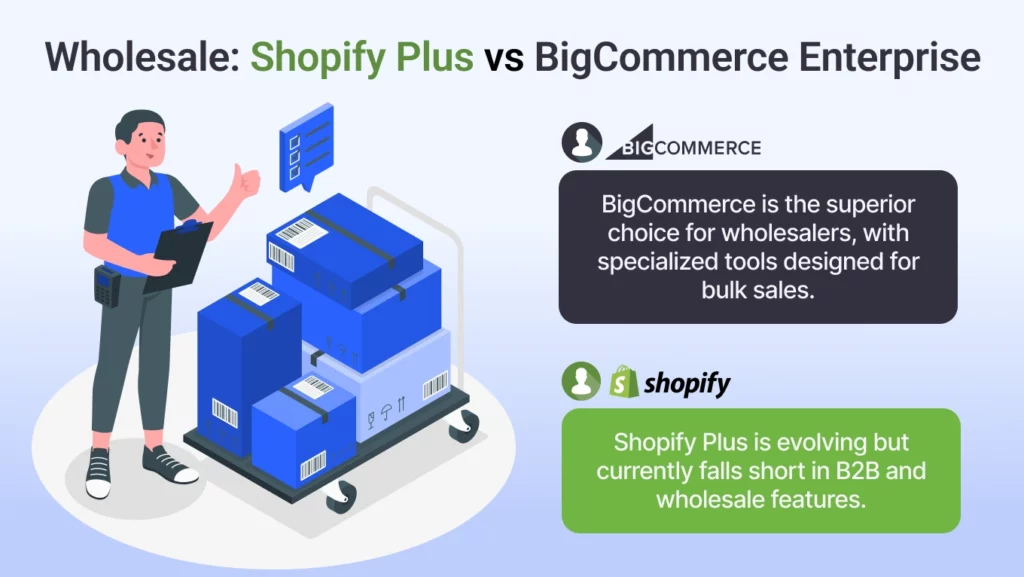
For B2B and wholesale, BigCommerce is the go-to platform, offering top-notch features like customer lists, quotes, purchase orders, price lists, payment terms, tiered pricing, and adjustable purchase limits.
Shopify Plus is improving, and even attempts to move in this direction through the Wholesale Channel, but still requires numerous additional integrations. It can’t match BigCommerce’s depth in wholesale support. If you’re a wholesaler, BigCommerce’s specialized tools make it the clear winner for handling bulk sales efficiently.
Meanwhile, M2E Cloud allows you to fully control your stock, track fast-selling products, and fulfill every order seamlessly. Say goodbye to costly inventory mistakes and lost profits!
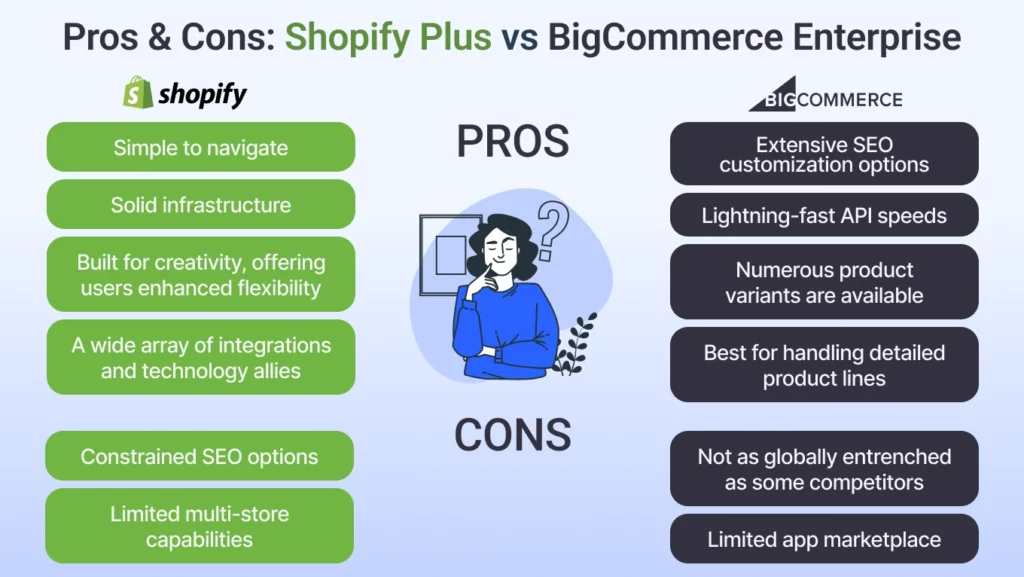
Shopify Plus vs BigCommerce Enterprise: Pros & Cons
Discover the strengths and weaknesses of Shopify Plus and BigCommerce Enterprise as we break down their pros and cons to help you choose the right platform for your business needs.
Conclusion
As you see, all based on what you’re aiming to achieve. If flexibility and B2B power are your game, go with BigCommerce Enterprise. For top-notch integrations and automation, Shopify Plus is your winner. Both platforms are eCommerce giants that can be integrated with the M2E Cloud. So, pick the one that matches your growth goals and start conquering your market! What do you think about it? Share your experience in the comment below, and remember to check our blog for more e-commerce insights.

