Temu keeps coming up when sellers talk about expanding to new sales channels. Most of them consider Temu for three reasons: lots of customers, quick setup, and a fast first sale. But new traffic helps only if the orders don’t end up in a separate place you have to check every day. That’s worth sorting out before you start listing on Temu.
This guide walks through Temu’s Local Seller Program the way it matters to a seller who runs other channels. You’ll learn what the program is, where you can sell, how to get set up, and how to run Temu sales with the rest of your channels through M2E Cloud.
About the Local Seller Program
Businesses that qualify can list on Temu while keeping their stock and deliveries within their own country. Since launching in early 2024, the program has reached 37 markets – most of Europe, plus the US, Canada, Mexico, Brazil, Japan, South Korea, Australia and the UAE. The original idea was to help local sellers reach local customers. Now, Temu has started expanding the program so eligible sellers can reach nearby and regional markets too.
Eligible sellers can list across more than 700 categories – apparel, household electronics and gadgets, everyday essentials, and plenty in between. The seller base is broad as well, from small family businesses and long-established manufacturers to large-scale distributors and international retail chains.
Selling on Temu Outside Your Home Market
In Europe, Temu is gradually letting sellers reach customers beyond their own country. A German seller, for instance, can take orders from Belgium without holding stock there, either through Temu’s logistics partners or their own shipping setup.
Since early 2026, sellers in Germany, Italy, the Netherlands, Portugal, Spain, Romania, Belgium, Poland, and France can also sell into the UK, Iceland, and Switzerland. American sellers gained access to Canadian customers in December 2025.
Selling into a new country usually means new warehousing and new logistics for you to manage. But with Temu’s seller program, you get extra reach without starting from scratch each time. As Temu opens more markets, you can expand there using your current stock and shipping setup.
How the Program Helps Your Business Grow
Growth on Temu comes from two sources: a large customer audience and how quickly you can start reaching them.
The audience is a result of how the marketplace works. Temu is discovery-based, so customers browse and come across products rather than searching for brands they know. A new seller can attract customers early, without an established reputation on the channel.
The speed is a result of a short setup process. You can expect free onboarding and quick registration. Temu shares the following timeline for getting live, although timing and sales performance vary by seller, market, category, and verification requirements:
- Application: around 10 minutes
- Approval: often within one business day
- Going live: many sellers within 72 hours
- First sale: about half of sellers within 20 days
Sellers in the program report that now they reach customer groups they couldn’t before, sell across more markets, and bring in additional revenue. Many of them put that money back into the physical side of the business, such as hiring locally, expanding a warehouse, or improving customer support.
Getting Started With the Local Seller Program
Onboarding on Temu includes four stages: create a seller account, submit your business information, verify the business representative, and finish your shop setup. The steps below are based on Temu’s US registration process, but details may differ depending on the country.
Step 1. Create your account
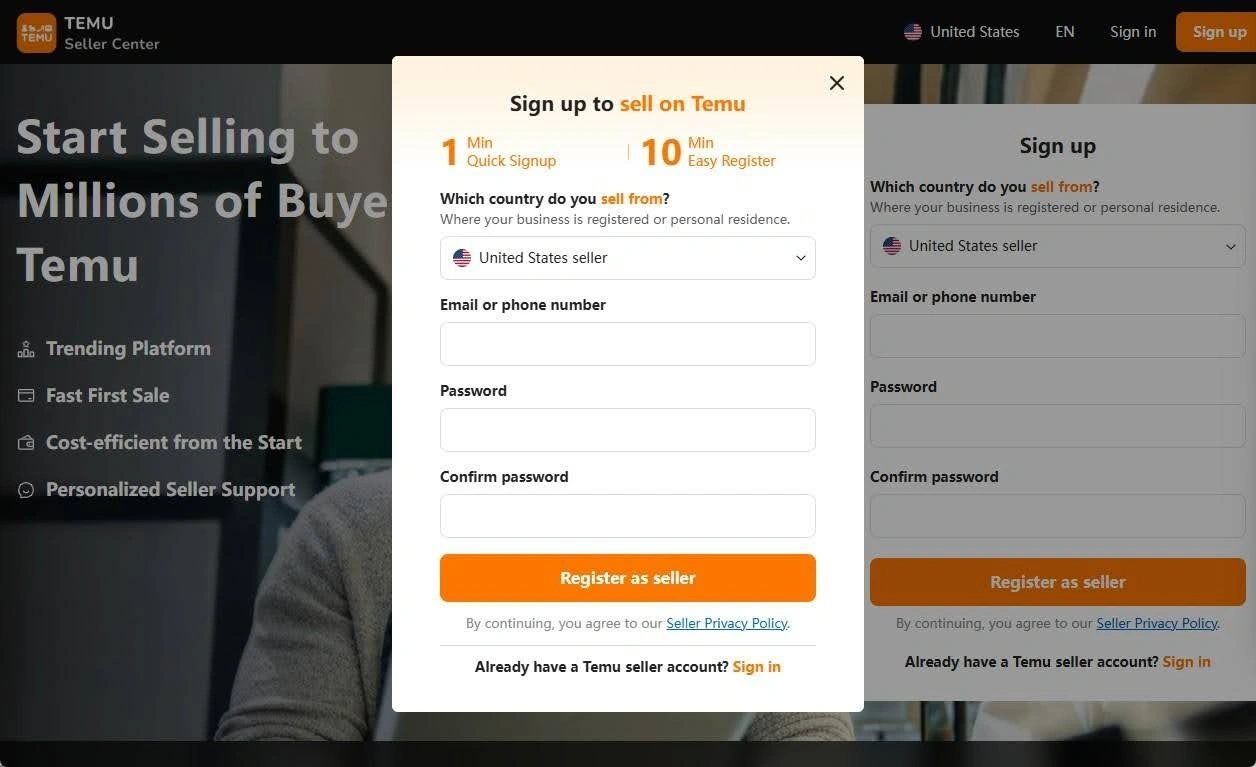
Head to the Temu Seller Center and click Sign up. Enter an email or phone number and set a password of at least eight characters, mixing letters, numbers, and symbols. Don’t reuse your email address or its prefix in the password. Click Register as seller.
Step 2. Choose your location and business type
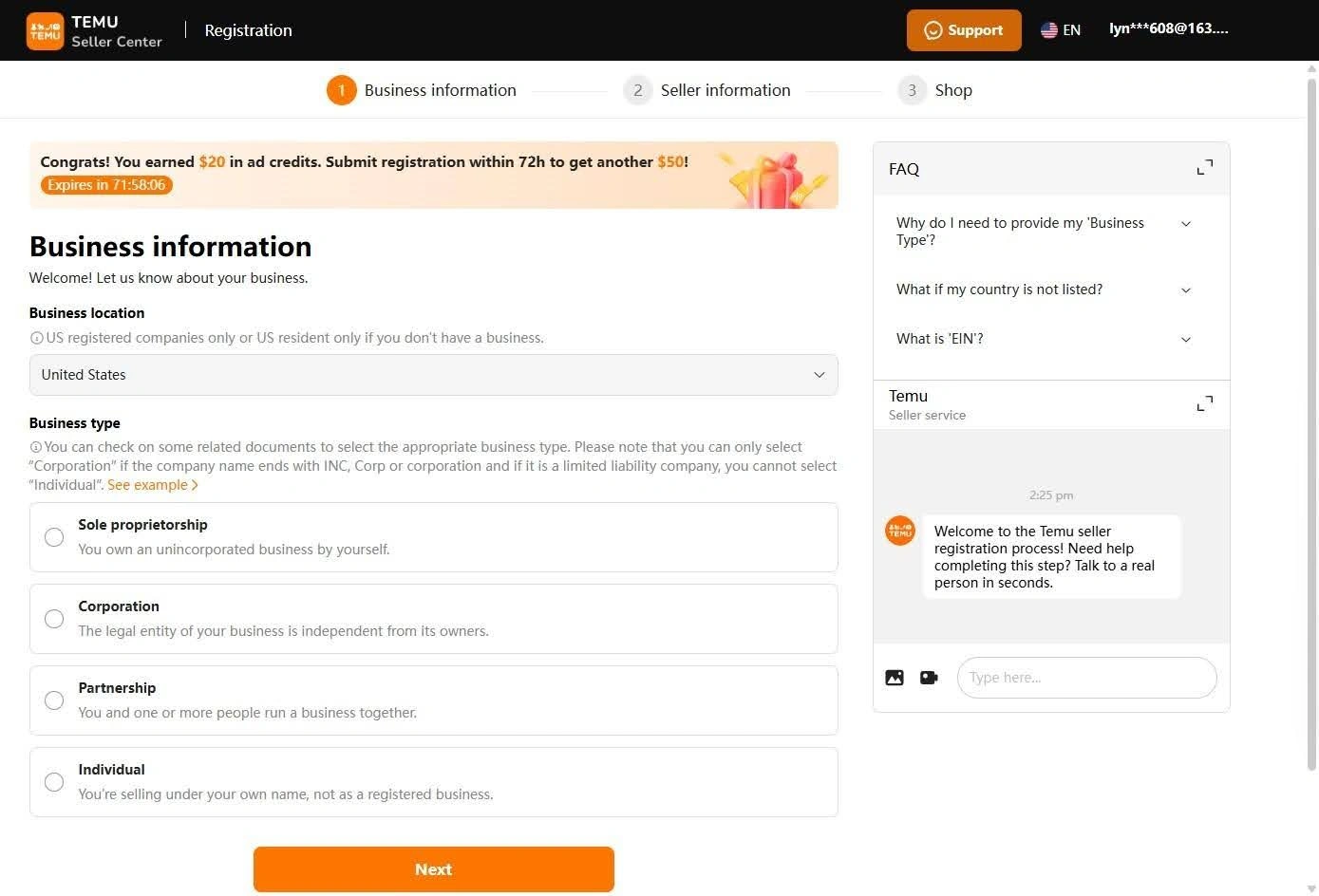
On the Business information page, pick your business location, then the business type that fits:
- Sole proprietorship – unincorporated business owned and operated by one person.
- Corporation – business that’s legally separate from its owners.
- Partnership – registered business owned by two or more people or entities.
- Individual – person selling under their own name rather than a registered business.
Step 3. Add registration details (if they apply)
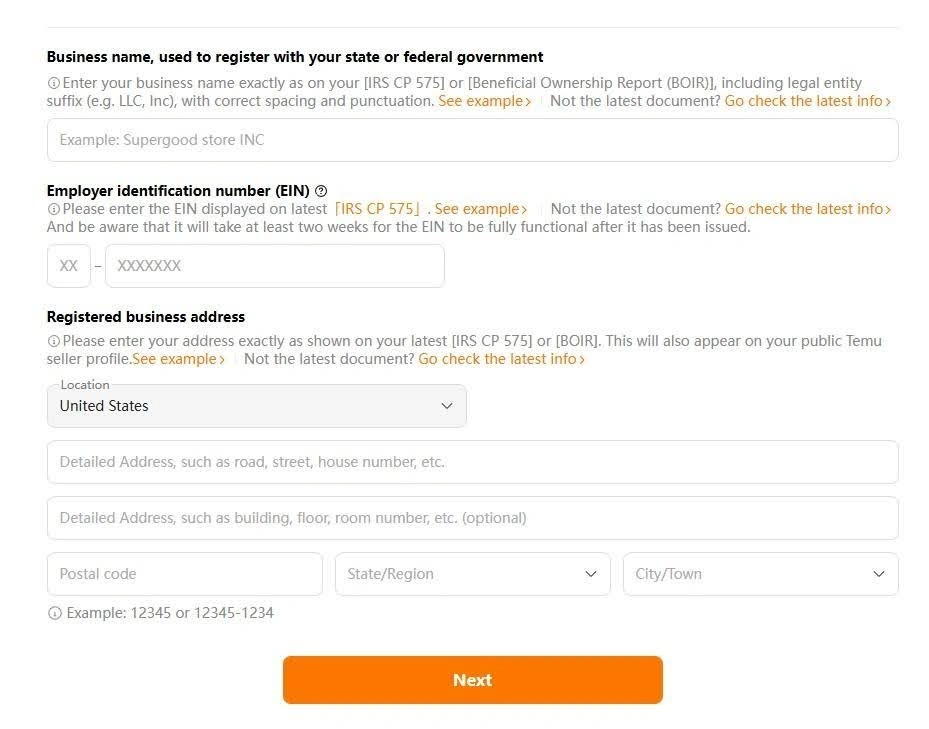
For any business type other than Individual, Temu asks for your registered business name, Employer Identification Number (EIN), and registered address. Match your official documents exactly:
- Business name – as it appears on your IRS CP 575 or Beneficial Ownership Report (BOIR), including the suffix (LLC, Inc.).
- EIN – as shown on your latest IRS CP 575.
- Registered address – as shown on your latest CP 575 or BOIR; this may appear on your public Temu profile.
Step 4. Verify and finish setup
At the Seller information step, pick the country that issued the representative’s ID, choose the ID type, and upload a photo. Verification runs through Jumio, an identity provider that checks IDs and screens for fraud. The file needs to be under 4 MB, in JPG, JPEG or PNG, valid, and clear enough to show all four corners.
Then, enter the representative’s details as they appear on the document: legal name, ID number, expiry, citizenship, place of birth, date of birth, plus their address.
Temu’s Seller Academy covers the extra steps you’ll need to complete your seller account setup.
How to Run Temu Alongside Your Other Channels
There’s always more to a new marketplace than the sales it brings. It’s another set of listings to create, another stream of orders, another stock count to sync. If all that is managed in a separate Temu dashboard you check on its own, you’ve added work rather than sales.
M2E Cloud is where that work goes instead. It’s multichannel software that connects Temu and other marketplaces with your e-commerce platform (Shopify, BigCommerce, PrestaShop, etc.). Using M2E Cloud, you can manage listings, orders, and stock from one place – your store admin. New orders land where the rest of your orders are, and inventory stays in sync so a sale on Temu adjusts your stock everywhere you sell.
M2E Cloud takes the repetitive work out of setting up your Temu listings:
- Copy listings from your existing channels. If you sell on eBay, Amazon, or Walmart, you can reuse those listings for Temu instead of building a catalog from scratch.
- Skip tedious category setup. Match your store’s categories and attributes to Temu’s, and that mapping is reused for every listing you create afterwards.
- Fix listing errors before publishing. M2E Cloud highlights invalid product details or missing attributes, so you can correct them on the spot and publish listings that meet Temu’s requirements.
Launching on Temu is easier when you can reuse your existing product catalog and listings. That’s what M2E Cloud gives you across supported Temu markets.
New to Temu Marketplace? Get a 30-day free trial of the M2E Cloud Temu integration along with personalized onboarding.
Success Stories From the Program
See how different companies took advantage of Temu’s local program to grow their business:
Don Ibérico (Spain). A fifth-generation Iberian ham and cured meats producer in Guijuelo, Salamanca, selling from its factory shop for over a century and traditionally focused on B2B sales. Current manager Álex Fernández launched an online store and a new brand, Monjamón. He used M2E Cloud to list his Shopify catalog on Temu, helping the business reach more customers directly and reach a new generation of digital-first customers.
Mcslots (UK). A family-run toy retailer that tested Temu in 2025 with part of its 3,900-product range. First orders arrived within 48 hours, and three months in, they were taking 40% more orders a day. Now Temu accounts for half of their total sales.
PopMarket (US). A collectibles and entertainment retailer started selling on Temu in late 2024 and sold more than 450,000 items in eight months. The retailer called Temu their fastest-growing digital marketplace in over a decade.
Ubedia (France). An ube-powder startup run by two 23-year-olds, which joined Temu in September 2025 and sold 1,300+ units in three months. It was enough for both founders to leave their day jobs.
FAQs About Temu Local Seller Program
Is Temu Worth It for a Small Business?
For many small and mid-sized sellers, yes. Selling online usually involves high upfront costs, a complicated setup, and a lot of work finding customers. The program is built to lower those barriers: joining is free, setup is quick, and there’s a large active audience. With Temu, you get access to traffic, infrastructure, and third-party services instead of building all of it yourself.
What Support Does Temu Provide to Sellers?
Sellers get direct help from Temu’s support teams, who answer questions and work through problems. On top of that, Temu gives access to extensive customer traffic, tools for customer engagement, and ERP integrations. It also works with logistics and payment partners to help sellers handle shipping and transactions.
Which Logistics and Payment Partners Does Temu Work With?
As for logistics, Temu works with USPS, UPS, and DHL, among others. For payments, it supports Google Pay, Apple Pay, PayPal, and Visa. More than 150 logistics firms handle Temu deliveries in Europe, and 10 national postal services have strategic agreements with the platform.
What Sets Temu Apart From Other Marketplaces?
Visibility, mainly. On more established marketplaces, smaller sellers struggle to get noticed. Temu works differently: customers browse and discover products, and sellers choose their own logistics and service providers. The idea is to give more sellers a chance rather than favoring a few large merchants. Temu gives more control over how businesses run sales, ship orders, and grow.
Final Thoughts
Temu built the Local Seller Program for merchants who already have sales running, on their own store, on other marketplaces, or both. You can sell from your existing stock, and your current fulfillment can cover the orders, including cross-border ones.
When adding Temu as a new sales channel, you need to make sure that listings, inventory, and orders stay in sync with your store and other channels. Otherwise, you’ll be updating products manually and risking overselling. M2E Cloud handles that synchronization and helps publish your products, so Temu runs through the same system as the rest of your sales.