Shopify Marketplace Connect and M2E Multichannel Connect both link your Shopify store with major US and European marketplaces. Their main idea is to keep key sales data in sync across all connected sales channels.
But what is the difference between them? And how to choose the right one for your business?
For sellers with a simple setup, marketplace coverage may be enough to make the choice. But growth can change more than the number of channels you sell on.
It is also worth asking:
- Which marketplaces do you want to expand to?
- Do your channels need different pricing or inventory rules?
- How large and complex is your catalog?
- Are Europe or other regions part of your plans?
- Do you need more control over marketplace data and synchronization?
- Could your ecommerce stack change as the business grows?
Here is where the two apps differ:
- Shopify Marketplace Connect
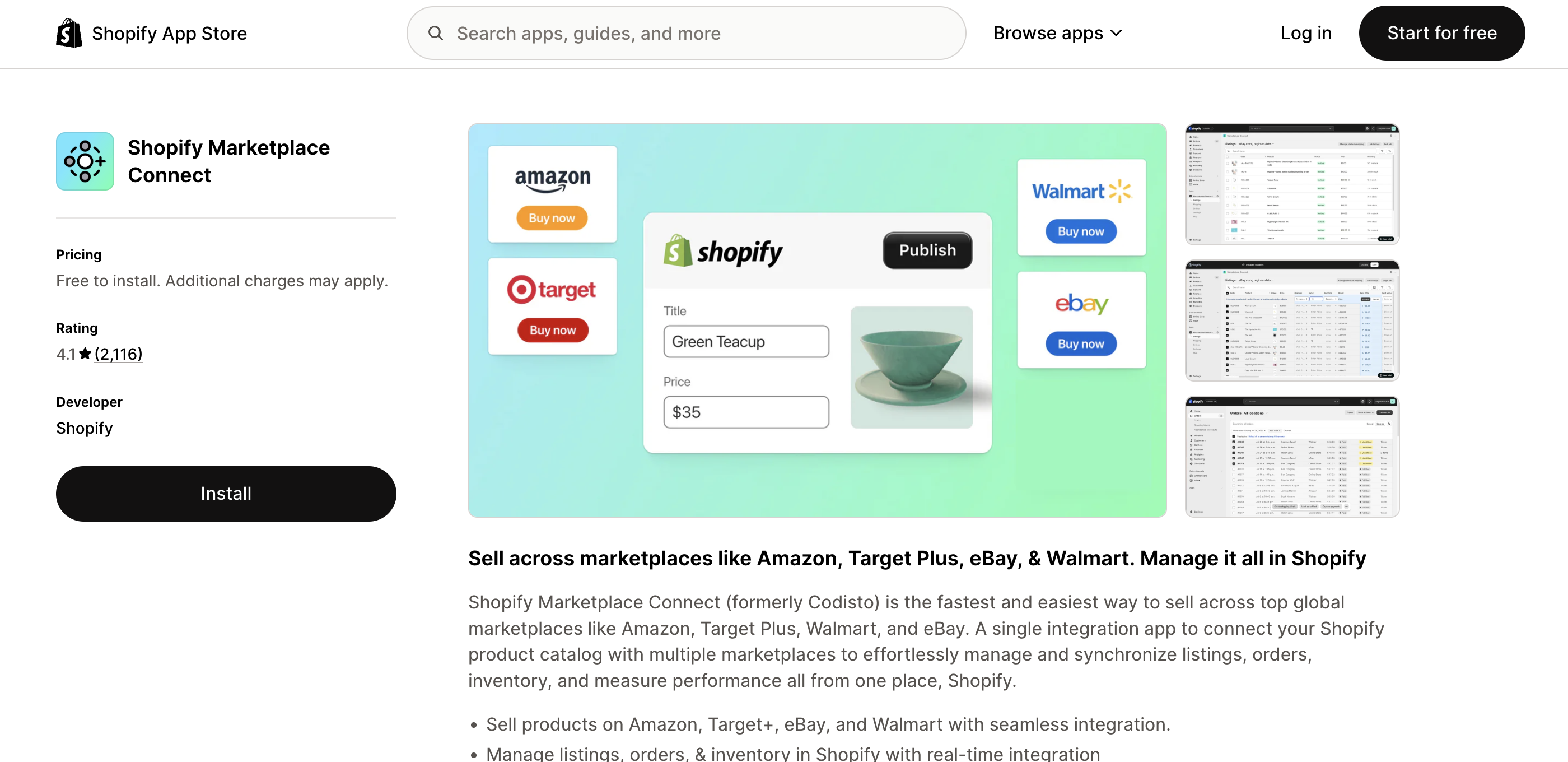
- Shopify-native app for managing Amazon, eBay, Target Plus, and Walmart Marketplace
- A straightforward option for sellers focused on a smaller number of major channels
- M2E Multichannel Connect
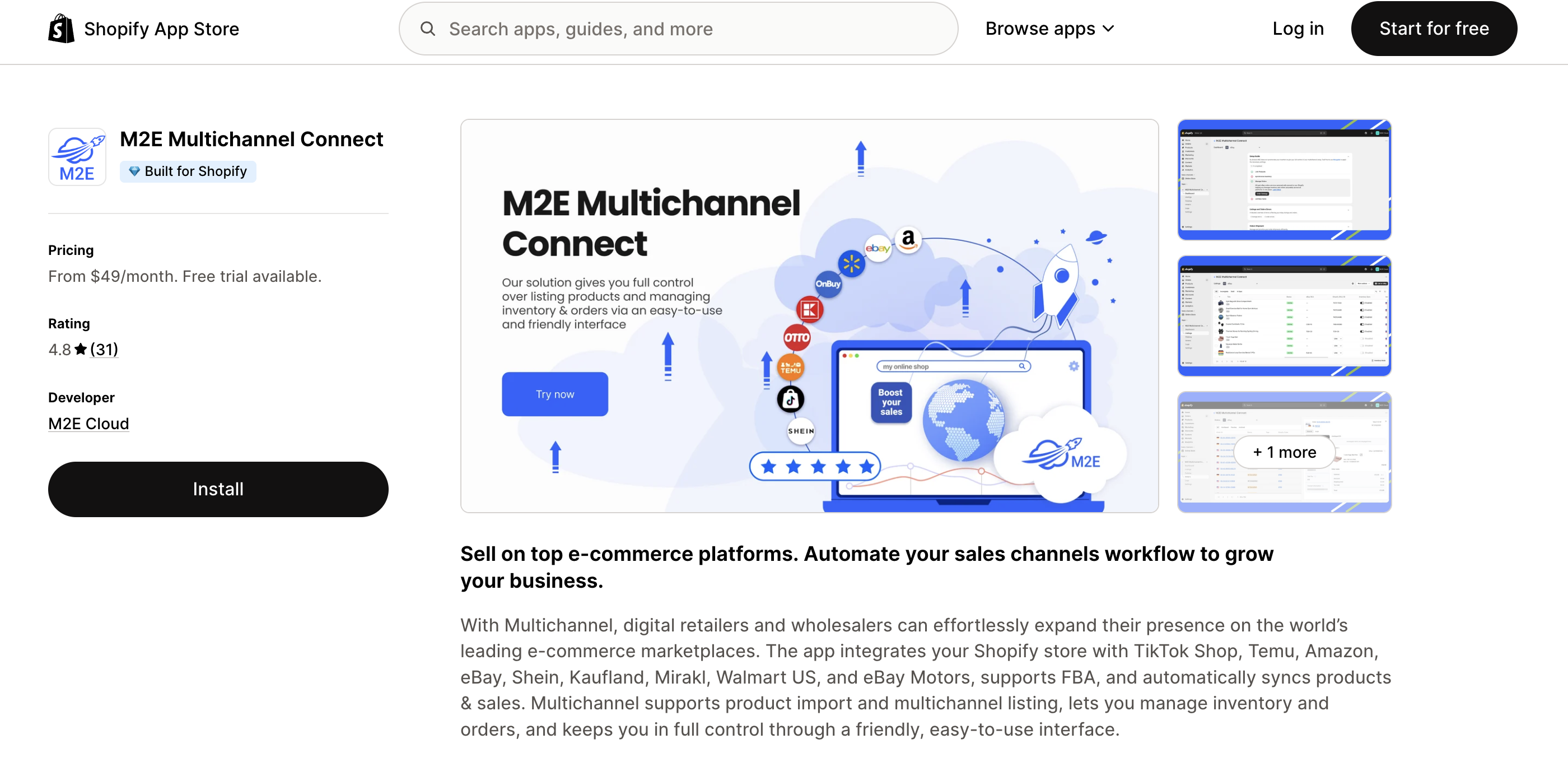
- Provides a Built for Shopify app experience that meets Shopify’s standards for performance, design, and integration
- Supports 600+ marketplaces across multiple regions
- Gives larger and growing businesses more flexibility in managing marketplace data and rules
In this guide, we compare both tools across the areas that matter most when choosing a marketplace integration:
- marketplace coverage;
- product, price, and inventory synchronization;
- large and complex catalog management;
- European and Mirakl marketplace expansion;
- support and onboarding;
- configuration and integration options.
Quick Comparison of Shopify Marketplace Connect vs M2E Multichannel Connect
Both apps can solve basic marketplace problems. What’s more interesting is the number of supported channels and the level of scalability each solution offers.
| Area | Shopify Marketplace Connect | M2E Multichannel Connect |
| Core tools | Listings, inventory, pricing, orders | Listings, inventory, pricing, orders |
| Additional tools | – | Analytics & Reporting, Product Data Hub |
| European and US marketplaces | Amazon, eBay, Walmart US, Target Plus | 600+ integrations, including Amazon, eBay, TikTok Shop, Temu, SHEIN, Kaufland, OTTO, OnBuy, and 450+ Mirakl-based marketplaces |
| Sync controls | Product, price, and inventory settings | Flexible rules by marketplace and product group |
| Large catalogs | Bulk management tools | Bulk tools, policies, and automation |
| Support | Shopify support | Live support, onboarding, docs, and video guides |
Two Marketplace Tools That Took Different Paths
The two products come from different backgrounds. Codisto was founded in 2015 and later expanded to Shopify, while M2E launched Multichannel Connect on March 31, 2023, using years of experience from M2E Pro and responding to requests from customers who wanted the same multichannel capabilities for Shopify.
Shopify Marketplace Connect stays close to Shopify
The product first launched as Codisto on September 19, 2017. In 2023, it became a first-party Shopify solution.
Its approach centers on Shopify:
- Shopify remains the main workspace;
- marketplace activity stays connected to the existing store setup;
- sellers can manage core channels without building a separate workflow;
- product and order management remain closely linked to Shopify.
This makes Marketplace Connect a practical option for sellers whose marketplace strategy fits within its supported channels.
M2E Multichannel Connect has expanded its scope
M2E Multichannel Connect launched as a native Shopify app in 2023 with support for Amazon, eBay, and Walmart. Since then, its marketplace network has grown much wider.
Today, it supports:
- TikTok Shop, Temu, and SHEIN;
- European channels such as Kaufland marketplaces, OTTO Market, and OnBuy;
- hundreds of Mirakl-powered marketplaces.
M2E keeps its focus on customization and automation:
- separate rules for different marketplaces;
- custom pricing and inventory policies;
- different settings for product groups;
- more control over synchronization;
- automation for large or complicated catalogs.
You, as a Shopify seller, get more freedom to adapt marketplace operations without moving you day-to-day operations from Shopify.
Where Can Each Platform Take Your Business?
The right marketplace mix depends on your growth plans. For example, if you’re focused on Amazon and eBay, you may have different needs from a seller who wants to expand into social commerce, the European market, or Mirakl-based marketplaces.
What does Shopify Marketplace Connect cover?
Marketplace Connect supports:
- Amazon
- eBay
- Walmart Marketplace
- Target Plus
Mind that Amazon and eBay can be used across supported regions and currencies. But Walmart Marketplace and Target Plus connections are limited to the US.
What does M2E Multichannel Connect cover?
M2E supports a wider channel mix, including:
- Amazon, eBay, and Walmart
- TikTok Shop, Temu, and SHEIN
- Kaufland, OTTO, and OnBuy
- eBay Motors
- Mirakl-powered marketplaces, including Decathlon, Douglas, and others.
M2E now offers access to 600+ marketplace integrations worldwide.
Broader coverage helps keep growth simple. You can add channels, regions, or systems without replacing the integration behind them.
How Much Control Do You Need Over Marketplace Data?
Synchronization isn’t only about keeping stock and prices updated. Growing sellers often need different rules for different parts of the catalog.
Shopify Marketplace Connect
Marketplace Connect gives sellers control over:
- marketplace attributes;
- custom listing content;
- price adjustments;
- inventory settings.
M2E Multichannel Connect
M2E goes further with reusable Synchronization and Selling Policies.
Sellers can decide how supported data should sync, including:
- price and quantity;
- titles and descriptions;
- images;
- categories and attributes.
They can also apply different rules to different product groups. For example:
- one pricing strategy for Amazon;
- another for eBay;
- reserved stock for selected products;
- separate rules for seasonal or low-stock items.
What Happens When You Need Help?
Both tools provide support, but they follow different approaches.
Support inside Shopify
Support stays within the Shopify ecosystem and includes:
- in-app chat;
- Shopify Help Center;
- guides for setup, listings, inventory, and orders.
Hands-on support with M2E
M2E combines self-service resources with direct human support. Sellers can use:
- in-app support;
- assisted onboarding;
- email and ticket support;
- detailed marketplace-specific guides;
- video tutorials;
- priority support for enterprise accounts.
Both tools provide setup guides, but M2E goes deeper into marketplace workflows. Its documentation covers:
- listings and account setup;
- pricing and inventory policies;
- category and attribute mapping;
- orders and fulfillment;
- listing errors.
How Flexible Is the Platform as Your Business Grows?
Let’s talk about marketplace requirements that tend to become more specific as a business grows. You have different brands, product groups, and channels, and all of them need different rules.
Built-in listing controls
Shopify Marketplace Connect offers several ways to adapt marketplace listings, including:
- bulk editing;
- attribute mapping;
- Shopify metafields;
- marketplace listing defaults;
- pricing and inventory adjustments.
Flexible policies and custom workflows
M2E Multichannel Connect adds a policy-based approach that gives sellers more control across larger and more complex catalogs. This includes:
- marketplace-specific synchronization;
- separate pricing and inventory policies;
- different rules for product groups;
- custom marketplace attributes;
- API connections with ERP, PIM, CRM, and other systems.
Additionally, M2E focuses on specialized requirements. For example, if you’re an enterprise seller with an unusual catalog structure and need custom integrations, M2E is ready to provide additional automation and marketplace-specific workflows.
Feedback from sellers can also help shape product development. This gives growing businesses more room to adapt their marketplace setup when standard settings no longer cover every requirement.

Which Tool Matches Your Growth Plans?
Your current marketplace mix is only part of the decision. It also helps to think about what your setup may look like in a year or two.
Shopify Marketplace Connect may fit your setup if
- Amazon, eBay, Walmart US, and Target Plus cover your marketplace plans;
- you prefer a first-party Shopify app;
- your marketplace workflows follow similar rules;
- you don’t need broader regional, social, or Mirakl marketplace coverage.
M2E Multichannel Connect may fit your setup if
- you plan to add more marketplaces over time;
- European or Mirakl marketplaces are part of your strategy;
- you manage a large or complex catalog;
- products need different pricing, inventory, or synchronization rules;
- you operate several marketplace accounts;
- you want assisted onboarding and direct human support;
- your stack includes ERP, PIM, POS, or other systems;
- your ecommerce stack may change as the business grows;
- you want to avoid rebuilding marketplace workflows every time you add a new channel or system;
- your marketplace setup may need more specialized configuration.
M2E was created as a more substantial multichannel ecosystem than an interconnected network built around a specific marketplace model or a particular stage of development. This gives companies more flexibility, as they can change their marketplace business model without necessarily changing the entire market infrastructure.
Instead of the Conclusion
Both tools can work well for Shopify sellers. The better fit depends on your growth plans.
Choose Shopify Marketplace Connect if you want:
- a focused marketplace setup;
- a Shopify-native workflow;
- support for a smaller number of major channels.
Choose M2E Multichannel Connect if you need:
- broader marketplace coverage;
- more room to expand internationally;
- more control over complex multichannel workflows.
The best choice fits both your current setup and your next stage of growth.