
A large market doesn’t always mean a better opportunity.
The basic clothing market can be crowded with similar offers, while niche sizing, specialist apparel, and seasonal products may give sellers a clearer position.
So, is it worth selling clothes on eBay as a business seller? It can be, if you choose the right products and understand the costs before you list.
This guide to selling clothes on eBay focuses on new fashion products sold by businesses, not second-hand items sold by private users.
We will break down the clothing categories with the strongest competition, explore areas with more potential, review the main eBay fees, and explain what to check when calculating whether a product can generate a healthy margin.
What Clothes Sell on eBay?
Fashion on eBay covers much more than everyday clothing. Business sellers can work across several major areas:
- women’s and men’s clothing;
- luxury and designer clothing;
- kids and baby clothing;
- sports and performance apparel;
- workwear and functional clothing;
- specialty and seasonal clothing;
- footwear and related fashion categories.
Opportunities differ from one segment to another. Broad categories often have strong demand, but they’re also crowded. More specific products can face less direct competition and help sellers target buyers with clearer purchase intent.
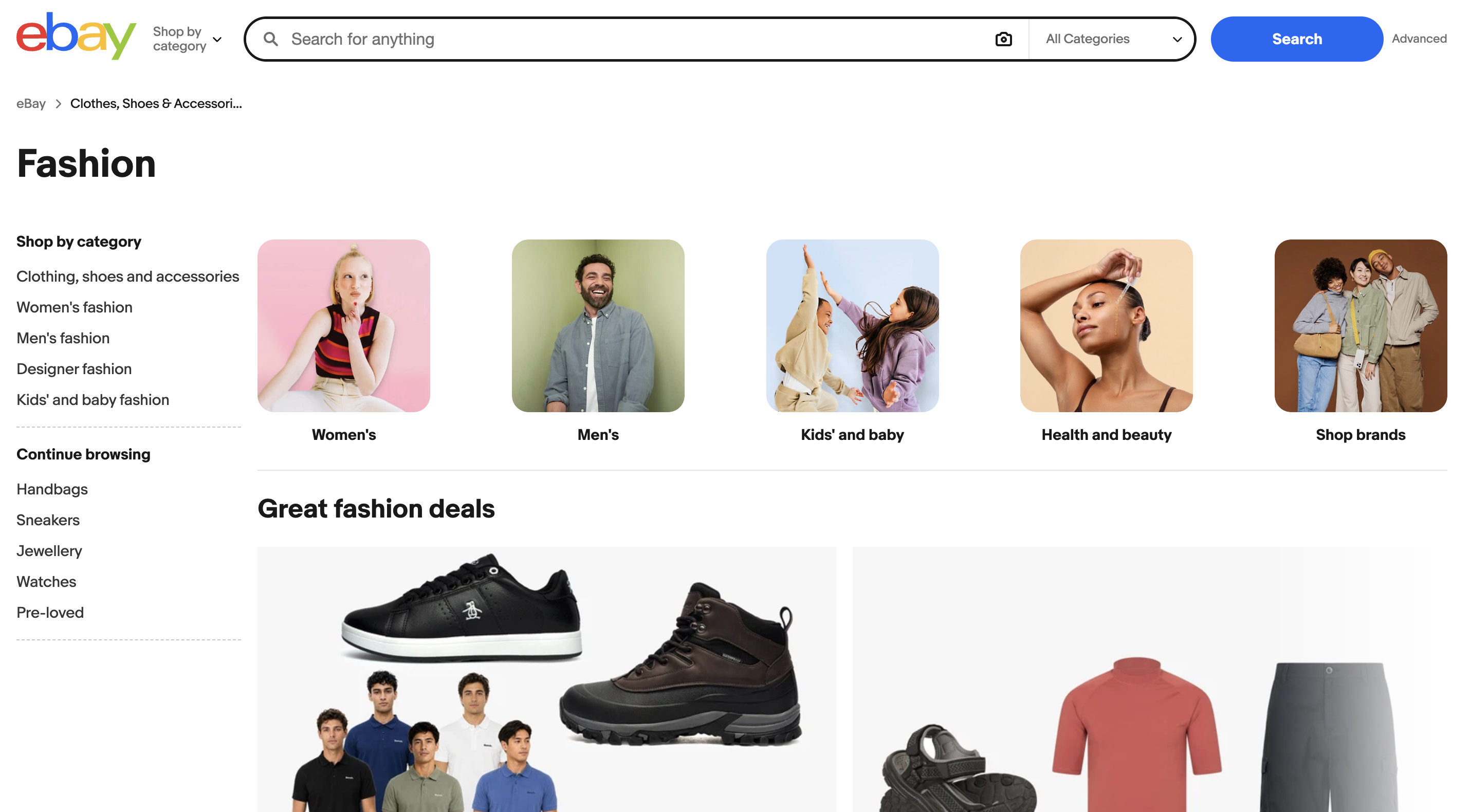
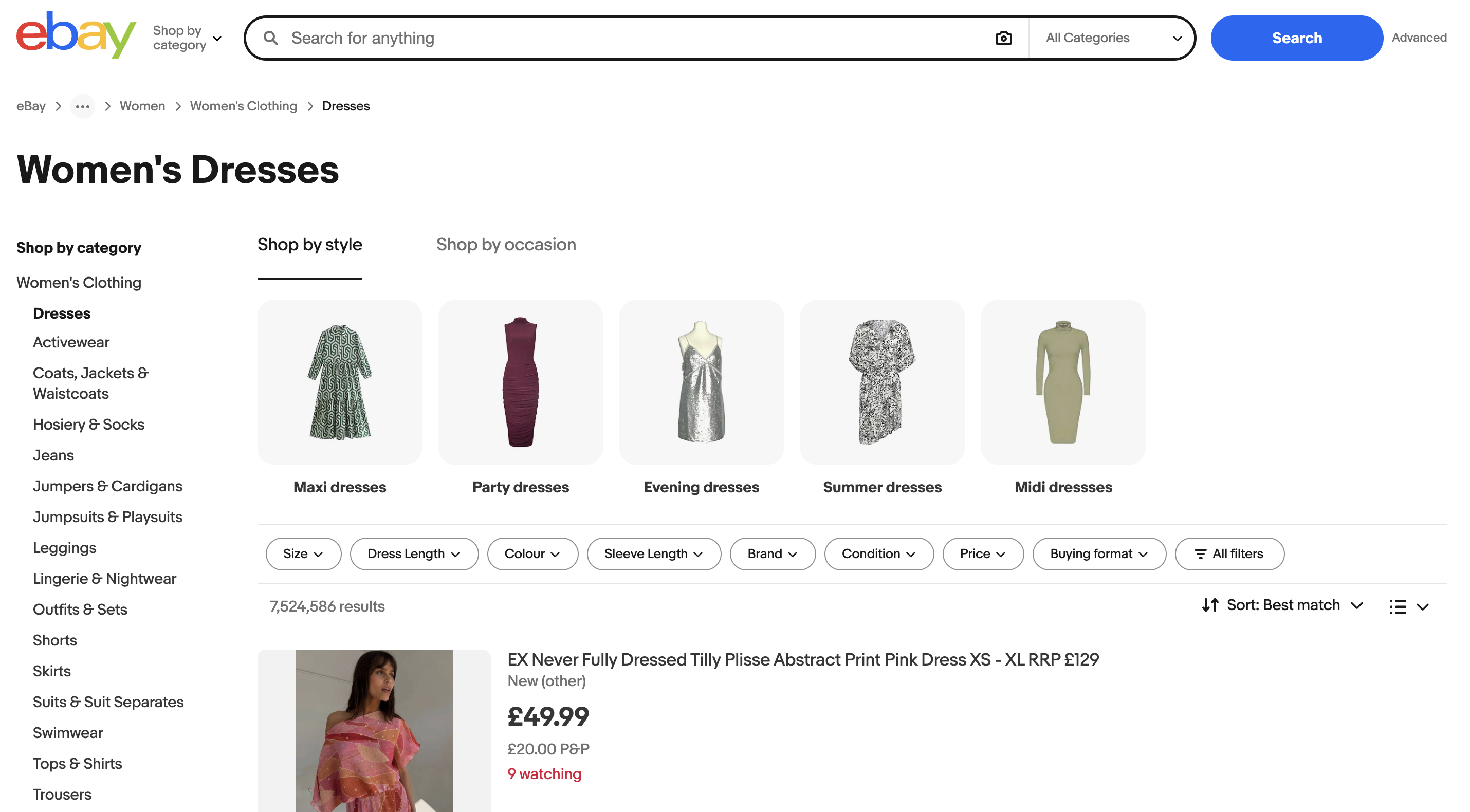
Well-structured listings make it easier for both eBay and buyers to understand your products. Accurate brand, size, color, type, and style details help eBay match listings with relevant searches.
They also give buyers the information they need to filter products quickly and compare similar options with confidence.
High vs Lower Competition Clothing Categories
A clothing category can look promising at first. Then you open the search results and see page after page of similar products.
That is why demand alone doesn’t tell the full story. Sellers also need to understand:
- how crowded the category is;
- what buyers compare before they purchase;
- how easy it is to stand out;
- whether there is enough room to protect margins.
The patterns below are most relevant to eBay UK and European markets. Competition can still change by country, season, brand, and price point.
Where is competition the strongest?
- T-shirts and basic tops. These products are easy to compare and widely available. Sellers researching how to sell shirts on eBay may get better results by focusing on a niche, stronger branding, specialist sizes, or multipacks.
- Women’s dresses. High SKU volume and fast-changing trends make this category demanding. Clear photography, accurate sizing, and complete style details are essential.
- Jeans and trousers. Buyers closely compare fit, measurements, brand, and price. Generic products need a clear advantage in sizing, design, or value.
- Trainers. Brand recognition and authenticity matter. Accurate product details and reliable sourcing matter.
- Fast fashion basics. Similar hoodies, sweaters, and tops often compete through price, shipping, reviews, and advertising. This can reduce profit margins.
Where may sellers find more room to grow?
- Niche sizing. Plus-size, petite, and tall clothing serve specific buyer needs. For sellers selling plus-size clothes on eBay, reliable sizing and a strong product range can boost visibility and repeat-purchase potential.
- Workwear and functional clothing. Uniforms, hi-vis items, and hospitality clothing are often chosen for practical features rather than trends.
- Outdoor and performance apparel. Buyers may compare weather protection, materials, insulation, and other technical features, giving sellers more ways to differentiate.
- Seasonal clothing. Christmas jumpers, festival outfits, and summer wear can see sharp demand peaks. Good timing and inventory control are critical.
- Regional and mid-tier brands. These brands can attract buyers without putting sellers directly against the biggest global fashion names.
- Multipacks and bundles. Clothing sets and multipacks can improve perceived value and help sellers compete beyond the unit price.
These categories show general patterns rather than fixed competition levels. Results will depend on your market, season, brand, and assortment.
Luxury fashion has its own advantage on eBay UK
Luxury and designer products can offer better margins than basic fashion, but buyers expect more reassurance before purchasing expensive items.
eBay provides this through its Authenticity Guarantee.
For eligible fashion priced at £200 or more, eBay:
- adds an Authenticity Guarantee badge to qualifying listings;
- sends sold items to professional authenticators before delivery;
- checks eligible returns before they go back to the seller;
- covers the authentication cost.
This gives fashion businesses an extra trust signal when selling eligible designer clothing, footwear, and accessories on eBay UK.
Authenticity Guarantee currently applies to eligible eBay.co.uk purchases shipped to UK addresses.
Quick Tip: Check Demand Before Investing in Inventory
High competition doesn’t mean there is no room to grow. The key is finding clothing segments where buyer demand can support another seller. Before ordering stock, use eBay Product Research to validate the opportunity with marketplace data rather than generic trend reports.
What can you check?
- Sell-through rate → Is there enough demand for this type of product?
- Sold price range → Can you sell at a price that still leaves enough margin?
- Number of sellers → How crowded is the niche?
- Postage costs → Will fulfillment make the product less profitable?
- Sales trends → Is demand stable, growing, or seasonal?
- Buyer and seller locations → Which eBay markets may be worth prioritizing?
These insights help you compare opportunities across the UK and European eBay markets. eBay provides up to three years of sales data in Product Research, while sell-through rate is available for searches covering items sold within the previous 90 days. Business sellers with an eBay Shop can also use Sourcing Insights to spot categories where demand is high, and supply is low.
How Much Does It Cost to Sell Clothes on eBay in the UK and Europe?
If you plan to expand your clothing range across eBay Europe, do not apply one fee assumption to every market. eBay sets fees at the marketplace level, and differences can affect your margin once you sell at scale.
Start with the marketplace fee
For example, as of August 2026, for business sellers, current clothing rates include:
- eBay UK: generally 11.9%, plus £0.30 per order up to £10 or £0.40 above £10 and a 0.35% regulatory operating fee.
- eBay Germany: generally 12% up to €990 and 3% above that threshold, plus €0.35 per order or €0.45 above €10.
- eBay France: generally 12%, plus €0.35 per order and a 0.35% regulatory operating fee.
Exact fees can change by category and subcategory.
Calculate the real cost of a sale
eBay calculates final value fees on the total amount of the sale. That includes the item price, postage, and applicable taxes such as VAT. eBay also publishes its business seller rates excluding VAT.
Your margin model should also include listing or Shop costs, international selling fees, advertising, fulfillment, returns, and the cost of goods.
Use:
Selling price − product cost − eBay fees − shipping − tax costs − expected return costs = actual margin
For larger catalogs, calculate this at SKU and marketplace level. A product that works in the UK may produce a different margin in European countries, such as Germany or France.
💡See our full eBay fees guides for more details.
How M2E Helps Fashion Sellers Run eBay at Scale
For fashion sellers, scale creates a different type of complexity. A catalog of 2,000 styles can quickly grow much larger once you count every size and color SKU. Add several European markets, seasonal price changes, and stock shared with other channels, and manual eBay management becomes difficult to maintain.
M2E Multichannel Connect keeps these operations connected.

Turn complex product data into structured eBay listings
Take a jacket available in five sizes and four colors. You shouldn’t have to rebuild the same product data for every option.
With M2E, you can:
- Create an eBay variational listing and connect its size and color options to your store products.
- Use store attributes for eBay item specifics such as:
- Brand
- Size
- Colour
- Style
- Material
- Fit
- Map store categories to eBay categories.
- Save Category Policies and reuse common attribute setups across multiple products.

This does more than save listing time. eBay uses item specifics to match listings to buyer searches and filters. Missing data can therefore affect discoverability.
It is particularly important for sizing. eBay UK introduced standardized apparel and footwear sizing in 2026 and may hide affected listings with missing or unclear size or condition values from August.
We know these Size Standardization changes can create extra work for eBay sellers, so M2E is introducing improvements to make the transition easier. M2E’s Listing Validator already checks for missing or invalid information during listing and revision, including non-standard Size values when eBay expects one of its approved options.
We’re also working on a dedicated Size Standardization tool to help sellers find active fashion listings with incorrect Size values and review them more efficiently. Stay tuned for updates as M2E continues adapting to eBay’s latest listing requirements.
Keep every size and color available at the right quantity and price
SKU fragmentation is one of the biggest inventory risks in fashion.
Suppose size S of a trainer sells out on eBay, but sizes M and L remain available. M2E links marketplace listings to the underlying store SKUs and synchronizes quantities so it updates the correct inventory.
Sellers can also add inventory controls:
- Reserve stock for other channels, replacements, or store orders.
- Limit displayed eBay quantity without changing the real quantity in your store.
- Keep price and quantity sync enabled as source data changes.
Pricing can also differ by channel or variation. You can:
- Pull a dedicated eBay price from a store attribute or metafield.
- Give individual variants different prices.
- Apply fixed or percentage markups or markdowns.
This can be useful when eBay fees, delivery costs, or promotional strategies require a different price than your ecommerce store.
💡Check out our guide on M2E Selling Policies to find out the details.
React faster to seasons, promotions, and order volume
Fashion teams may need to update hundreds of products when a sale starts or a collection changes.
Rather than revising each eBay listing, M2E can synchronize:
- Prices and quantities
- Titles and descriptions
- Images
- Categories and item specifics
- Shipping and Return Policies
eBay orders can also flow into your existing store workflow. Relevant order status changes, including Shipped, Canceled, and Refunded, can synchronize between systems.
For returns, M2E lets you create different policies for different marketplaces or product groups. For example, your international collection can use different return conditions from domestic UK listings.
💡 Here is more on how to configure your ecommerce store and eBay with M2E.
Keep refunds and returns in sync
Refunds and returns can create extra work when you sell on several marketplaces. M2E Multichannel Connect helps keep order data aligned between your store and supported channels.
Depending on the workflow, M2E helps you:
- sync refund and return information;
- update order statuses in your store;
- record partial or full refund amounts.
💡 For more information check out our docs on how to sync eBay refunds and returns with your store.
Use the same operation as you enter more markets and channels
Expansion doesn’t have to mean creating a separate catalog workflow for every marketplace.
For eBay, M2E supports:
- Domestic and international Shipping Policies.
- Destination exclusions.
- Shipping Rate Tables on major European sites such as the UK, Germany, France, Italy, and Spain.
- eBay’s Global Shipping Programme for eligible UK listings.
The same source catalog can also support marketplaces such as Amazon, TikTok Shop, and Walmart, while each channel keeps its own categories, attributes, prices, and policies.

Build GPSR data into your EU workflow
For products subject to GPSR in the EU, M2E lets teams maintain manufacturer and Responsible Person data centrally and submit it to eBay through listing synchronization.
You can also see which products have GPSR information assigned, which becomes more valuable when you manage compliance across thousands of SKUs.
What About eBay Pricing Strategies for Fashion Sellers?
A good promotion strategy should reflect the role each product plays in your catalog. New-season items, core basics, and ageing inventory don’t need the same offer.
Use discounts for broader promotions
For larger campaigns, eBay Store subscribers can use several types of discounts:
- Clear seasonal inventory: use Sale events for last-season jackets, dresses, or footwear.
- Sell more units: apply Volume discounts to basics, multipacks, or products buyers often purchase together.
- Increase basket value: use Order size discounts across related products or collections.
- Encourage larger orders: offer Shipping discounts when customers buy more.
With M2E Multichannel Connect, you can manage these discounts across multiple fixed-price listings. You can retrieve discounts created on eBay, filter listings by the discount applied, and add or remove discounts in bulk.
For a large fashion catalog, this removes a lot of manual work. For example, when a season ends, you can select the relevant products and apply an existing Sale event across the range instead of editing every listing.
💡Explore eBay Discounts in M2E Multichannel Connect.
Use Best Offer when you want more pricing flexibility
A public discount is not always the right choice. eBay Best Offer lets you keep the listed price while giving interested buyers room to negotiate.
This can work well for:
- branded or higher-margin fashion;
- higher-priced products;
- slower-moving stock;
- items where you have some room to negotiate.
You can accept, decline, or counter a buyer’s offer. With M2E Multichannel Connect, you can also set price-based rules to automatically accept offers above a chosen threshold or decline offers that are too low.
This gives you more flexibility without reducing the public price for every buyer.
Whichever pricing strategy you use, check the margin first. Discounts and Best Offers can help move stock, but only if the final selling price still covers your marketplace fees, fulfillment costs, returns, and target margin.
So, Is It Worth Selling Clothes on eBay?
For the right assortment, yes. But treat eBay as a channel to validate and scale – not as a reason to invest in inventory blindly.
A stronger approach is to:
- Research demand first. Use eBay Product Research to compare sales, prices, competition, and sell-through rates.
- Calculate margin by SKU and market. Include eBay fees, shipping, tax costs, advertising, and expected returns.
- Choose products with a reason to win. Brand strength, differentiated styles, exclusive ranges, or better sourcing give you more room than generic basics.
- Get product data right. Accurate sizes, colors, fit, and other item specifics affect how easily buyers can find your listings.
- Scale only what performs. Make sure stock remains accurate for every variation as order volume grows.
Once you find products that meet these conditions, M2E Multichannel Connect can handle much of the operational work behind scaling eBay – from variations and inventory to pricing, orders, and additional sales channels.