A size value that reads “Small” or “See description” used to be good enough for an eBay fashion listing. Since August 2026, it isn’t. eBay now accepts only standardized values in the Size item specific for Apparel and Footwear. Listings with custom, missing, or unusable values can be blocked or placed on hold.
This guide covers what eBay changed and which size values the marketplace accepts now. You’ll also learn how to send the correct values to eBay without rewriting the size data in your store catalog.
What’s Changing With eBay Size Values
Since August 2026, eBay accepts only standardized values in the Size item specific for Apparel and Footwear. Values it can recognize, like “Small”, are converted to the standard equivalent.
Values eBay can’t interpret, for example, “See description”, stop the listing from being submitted or revised. The listing comes back with an error: “See description is not a valid value for Size. Select a value from the available options.” A missing Size value also affects the listing.
The reason behind the change is search. eBay’s size filters only work with standard values. If your Size field says “Medium” instead of “M”, buyers who filter by “M” won’t see your listing at all. The listing is live on the site, but the customers searching for it can’t find it. For example, on the eBay US marketplace, 17 to 21% of Apparel and Footwear listings used non-standard sizes, so a lot of stock was missing from the filtered search results.
The change covers new and existing listings alike, and applies whether you list on eBay directly or through a third-party tool.
Which Size Values eBay Accepts
eBay defines the allowed value list per category, so a footwear category accepts different values than a women’s tops category. Supported values also differ by marketplace, so if you sell Fashion on several eBay sites, check the values each one accepts.
Among the supported formats are:
- Alpha sizes: 2XS, XS, S, M, L, XL, XXL.
- Numeric sizes: where the category supports them.
- Region-specific formats: US, UK, EU.
Here is how eBay handles size values in different listing scenarios:
| Size value in your catalog | Example | Result on existing listings | Result on new listings |
|---|---|---|---|
| Standard for the category | S, M, L | Accepted | Accepted |
| Recognizable but not standard | Small, Medium | Converted to the standard value | Can’t be submitted |
| Missing or unusable size | N/A, See description, Does not apply, empty field | Listing blocked or held | Can’t be submitted |
Automatic conversion may look like a simple fix because it can keep existing listings live on eBay. The problem is that it creates a mismatch between the two systems: your store says “Small”, while eBay shows “S”. When the original catalog value is sent again during the next sync, eBay converts it again.
Note that the new requirement concerns the Size item specific only. eBay descriptions and titles have no such restriction, so you can keep describing sizes there in your own words.
Which Catalogs Need Attention
Sellers listing directly on eBay now choose sizes from a drop-down list. But if you list on eBay through your store catalog, review your Size attribute carefully. It may contain values created for your storefront or other sales channels, not for eBay’s standard size list.
Check the Size attribute in your catalog for any of the following:
- Non-standard labels. Your store uses “SM”, “UK Size 12”, or “Ladies M” rather than the standard values eBay accepts.
- Mixed formats in one value. “Small (UK Size 8)” has the alpha size and the region-specific size together, while eBay expects one value.
- Size ranges. “S-M” or “6-12 months” covers two sizes at once, but eBay’s Size specific takes a single value.
- Supplier feeds. Every brand sends sizes in its own format, so one catalog can contain “M”, “Medium”, and “Mens M” for the same size.
- Placeholders. Some products have “N/A”, “See description”, or an empty Size field.
- Shoe sizes without a region. “42” means a different size in each region, and some footwear categories expect US, UK, or EU Shoe Size as a separate specific.
- Variant-level values. Every variant has its own size value, and one non-standard value can stop the whole listing.
If you’ve found the non-standard values used for your eBay listings, you need to fix them in a way that satisfies eBay and preserves the existing product data in your store.
How to Get Accepted Size Values onto eBay
There are two ways to bring your size data in line with eBay’s requirements. The right option depends on whether the current value contains real size information.
1) Change the Size Value in Your Catalog
This means replacing the size value in your store. For example, “UK Size 12” becomes “12”, and eBay receives an accepted value directly. For placeholders and empty Size fields, this is the only option. “See description” and blank fields don’t contain size information, so you have to enter the correct size in the store.
Values like “UK Size 12” that do carry a real size are worth keeping as they are. Your customers recognize this format on your storefront, your other marketplace listings rely on it, and your sales reports group products by it. If you change the size value to “12” only to satisfy eBay, you also change what your storefront displays and what your other channels receive.
2) Map the Size Value Specifically for eBay
With mapping, your catalog keeps the original size value, and eBay receives a standardized one. Your store continues to show “UK Size 12” on the storefront, your other marketplace listings keep using the same source value, and your reports remain consistent. The eBay listing receives “12”.
Mapping is set per value, not per product. You match “UK Size 12” to “12” once, and it applies to every product using that value. The same approach works for any other size value written in your own format.
The rule is simple: if the Size field doesn’t give eBay a real size, update it in your store. If the size is real but written in a format eBay doesn’t accept, map it to the correct eBay value instead.
What If Your Catalog Uses Size Ranges
Some catalogs store a range rather than a single size: “S-M”, “6-12 months”, “10/12”. This is common in children’s clothing and footwear, where sizing systems overlap and a garment fits more than one size.
eBay’s Size specific accepts one value, and ranges aren’t supported. In this case, you need to choose the single most appropriate size and map the range to it. “S-M” goes to eBay as “M”, “10/12” as “12”. The range itself stays in your catalog, and you can spell it out in the title and description, where no restriction applies.
You can set up the mapping in M2E Multichannel Connect, so the standardized size value is sent to eBay while your store keeps its original data.
How M2E Resolves Unsupported Size Values
When you list or revise products from your store on eBay, M2E Listing Validator Assistant checks your data against eBay’s requirements before the channel returns an error. Unsupported Size values are one of the issues it detects.
1) The invalid Size value is marked for review.
Listing Validator Assistant highlights the attribute with the unsupported value and explains that eBay allows only a fixed set of values for Size. You can see how many products are affected and export the list.

2) You choose how to resolve the issue.
Mapping the store Size attribute values to eBay Size specific values is the recommended option. You can also choose another source attribute for Size or update the value directly in your store catalog.
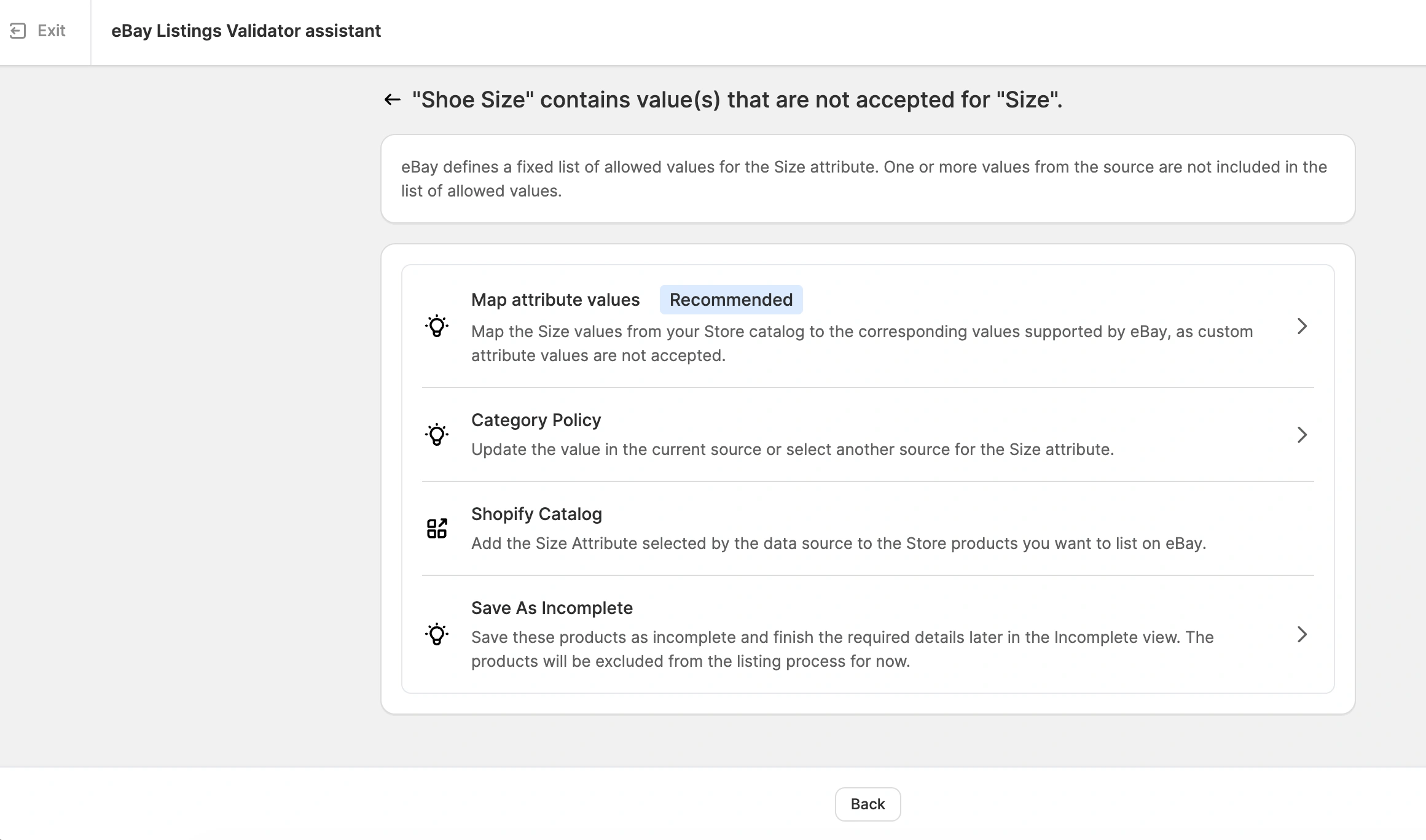
One more option is to save the products as incomplete, so they are skipped during this listing run instead of blocking it.
3) You map value to value.
If you’ve selected the mapping option, M2E lists your catalog values and lets you map each one to the accepted eBay value.
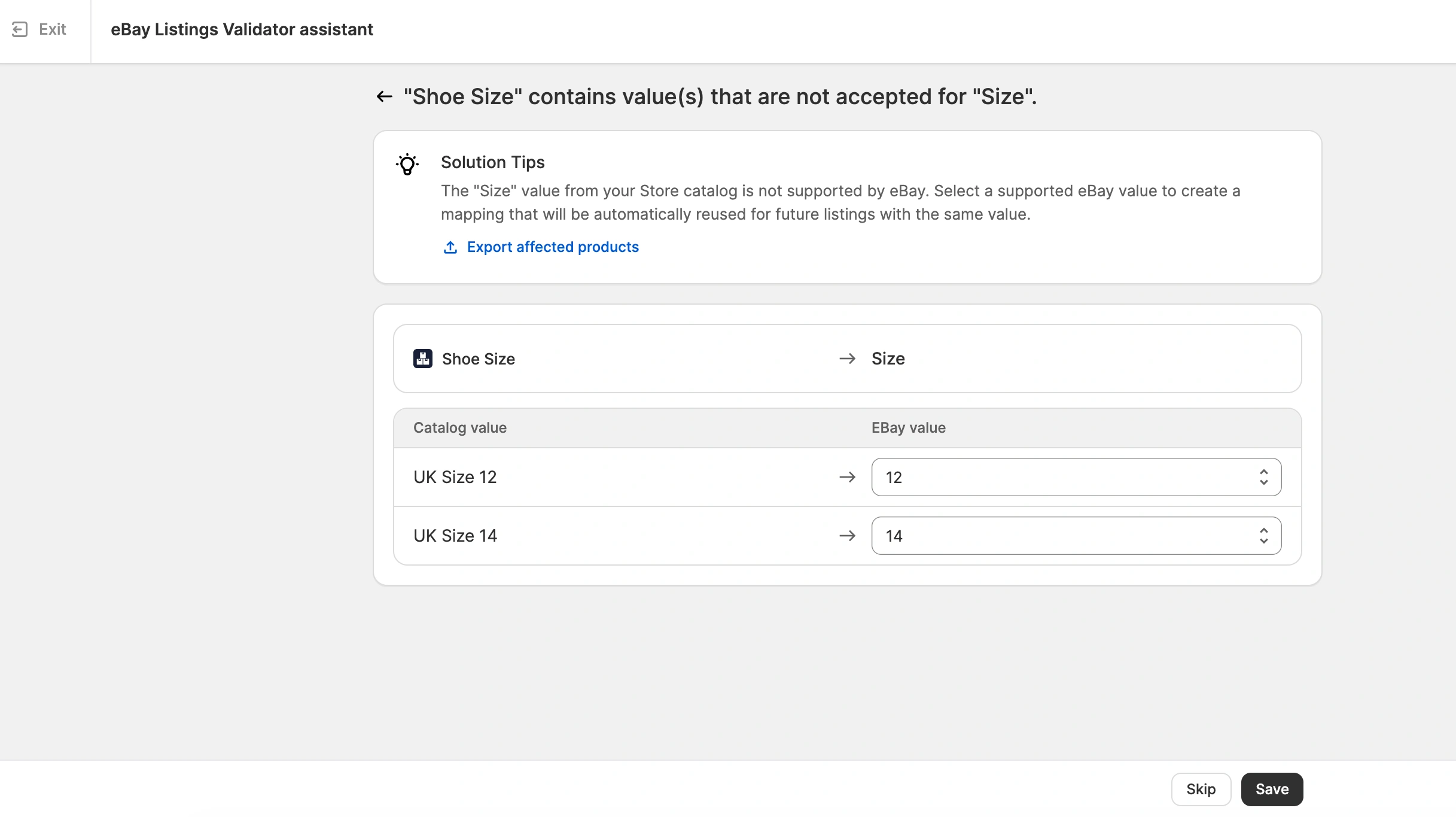
4) The mapping is saved and reused.
M2E lets you save the mapping and apply it automatically to future listings with the same Size value. You can reuse the saved mappings across other categories.
Once the issue is resolved, the listing publishes with the mapped value. As a result, you get a clean split between systems: your catalog remains the source of truth, and eBay receives the standardized value it needs.
Mapping helps resolve issues with non-standard size values as you list or revise items. For listings that are already live with unsupported or inconsistent values, M2E is working on a separate size standardization view that will help you find them and map the values in bulk.

Size Mapping for eBay Variations
Variation listings have an extra requirement. eBay needs a valid value for every variation option, so one unsupported or unmapped value can stop the whole listing.
Mapping in M2E works the same way for variations as it does for Simple products. When you add size options to an eBay listing from your store variants, the Validator shows your catalog values. You can choose the correct eBay equivalent for each value. This way, your catalog keeps its original variant values, while eBay receives the standardized values required for listing.
With M2E Multichannel Connect, your variation structure stays as it is. You don’t need to split a Variation listing into separate Simple listings just to submit standard sizes to eBay.
Conclusion
Size values are one part of a larger pattern. Marketplace requirements change, and Size may not be the last item that eBay standardizes. When requirements tighten, the sellers who can adapt their store data without rewriting the catalog will have an easier time keeping listings active and accurate.
M2E Multichannel Connect gives you that flexibility. You can map store values to the format eBay expects and reuse those mappings where they fit. Your catalog remains structured in a way that works for your storefront, reports, and other marketplaces.